A tiny AI storyteller (ESP32-S3)
A real 28.9-million-parameter TinyStories language model (slvDev/esp32-ai, MIT) running entirely on the emulated ESP32-S3: the 15.5 MB app image with the embedded model fills a 16 MB flash chip, the int8-staged weights and KV cache live in the 8 MB octal PSRAM, and both LX7 cores split every matrix row. The story streams to the big 2.8″ color TFT — your prompt in yellow, the tale in white, and a live tokens-per-second footer fed over real hardware SPI (every pixel costs honest bus time). Type a few words into the serial monitor and press Enter: the model tokenizes your prompt on-device and writes you a new story at its true hardware-class rate, ~8 tokens/second with the panel attached, courtesy of the JIT that compiles the hot int8 dot-product loop to WebAssembly on the fly.
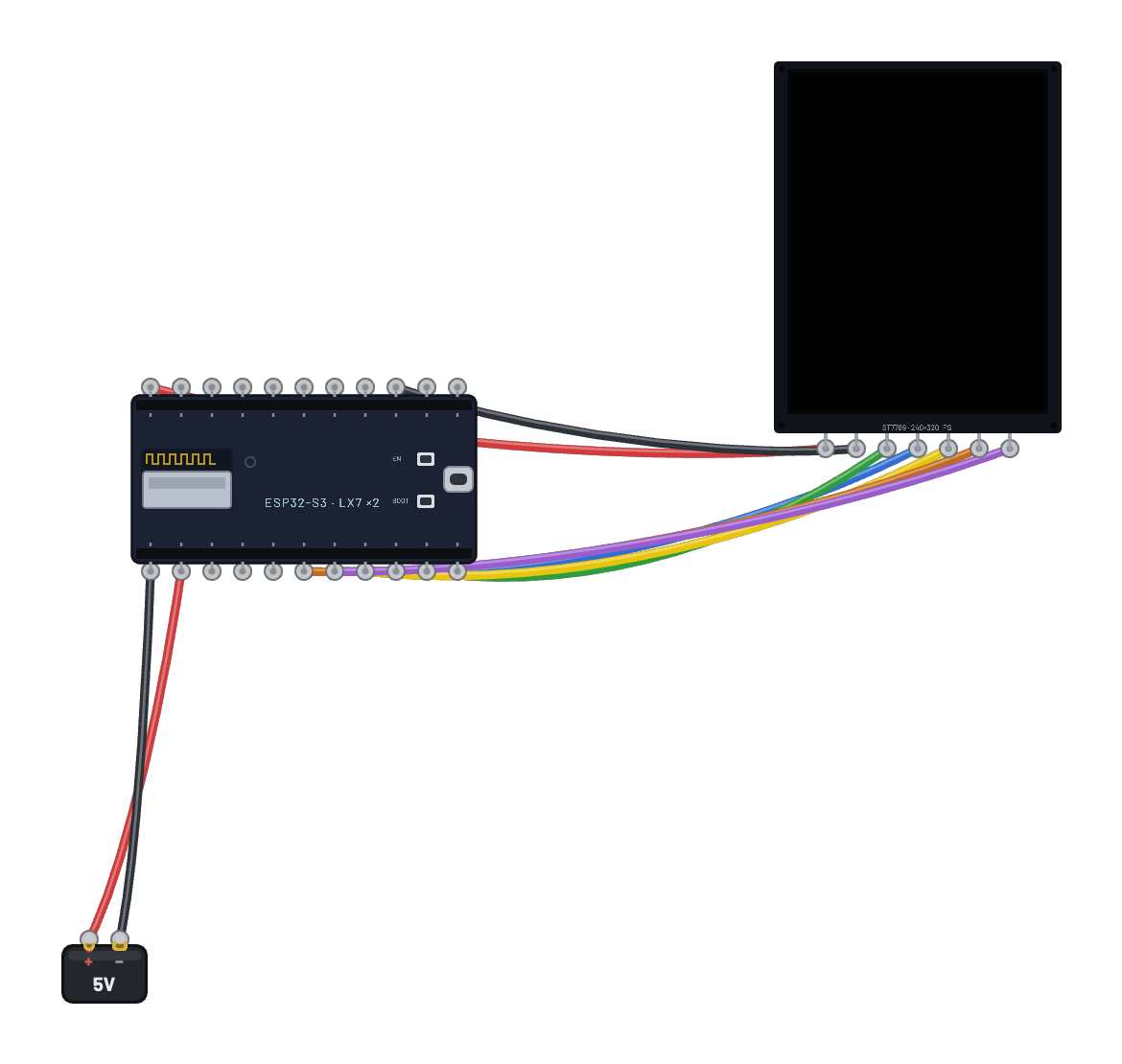
What's on the bench
- Battery
- ESP32-S3
- TFT 2.8″ 240×320 (ST7789)
How it's wired
- Battery · pos→ESP32-S3 · vin
- Battery · neg→ESP32-S3 · gnd
- ESP32-S3 · 3v3→TFT 2.8″ 240×320 (ST7789) · vcc
- ESP32-S3 · gnd2→TFT 2.8″ 240×320 (ST7789) · gnd
- ESP32-S3 · g6→TFT 2.8″ 240×320 (ST7789) · clk
- ESP32-S3 · g7→TFT 2.8″ 240×320 (ST7789) · din
- ESP32-S3 · g5→TFT 2.8″ 240×320 (ST7789) · cs
- ESP32-S3 · g3→TFT 2.8″ 240×320 (ST7789) · dc
- ESP32-S3 · g4→TFT 2.8″ 240×320 (ST7789) · rst
The code
The exact ESP-IDF v5.3.5 project the bundled firmware was compiled from — shown in the simulator’s Code tab, where you can edit the sources and press Compile & run to rebuild the board’s firmware in the cloud sandbox.
CMakeLists.txt
cmake_minimum_required(VERSION 3.16)
include($ENV{IDF_PATH}/tools/cmake/project.cmake)

# Upstream ships at global -O3 (scripts/deploy.sh; matvec_i8_range carries the
# one noinline the runtime needs). -ffp-contract=off on top: the host oracle
# (host/build.sh) compiles the same llm.h with the same flag, so neither side
# fuses a*b+c into an FMA the other did not — the story diff must compare
# arithmetic, not compiler contraction choices.
idf_build_set_property(COMPILE_OPTIONS "-O3;-ffp-contract=off" APPEND)

project(ple-s3)
sdkconfig.defaults
# ple-s3 — deterministic 28.9M PLE TinyLM inference on the ESP32-S3 N16R8.
CONFIG_IDF_TARGET="esp32s3"

# 16 MB flash, custom table: one 15.875 MB factory app holding the embedded
# 14.9 MB model. (esp32s3-memprobe/sdkconfig.psram is the base profile.)
CONFIG_ESPTOOLPY_FLASHSIZE_16MB=y
CONFIG_PARTITION_TABLE_CUSTOM=y
CONFIG_PARTITION_TABLE_CUSTOM_FILENAME="partitions.csv"

# 8 MB octal PSRAM (DevKitC-1 N16R8). SPIRAM_BOOT_INIT + the boot memtest
# stay on: reaching app_main proves the octal bring-up and the full sweep.
CONFIG_SPIRAM=y
CONFIG_SPIRAM_MODE_OCT=y
CONFIG_ESP32S3_DATA_CACHE_32KB=y

# Full 240 MHz. The project CMakeLists appends -O3 -ffp-contract=off (see the
# comment there); COMPILER_OPTIMIZATION_PERF keeps IDF's own default sane.
CONFIG_ESP_DEFAULT_CPU_FREQ_MHZ_240=y
CONFIG_COMPILER_OPTIMIZATION_PERF=y

# One console only: the default secondary USB-Serial-JTAG console duplicates
# every byte in the emulator's merged serial stream.
CONFIG_ESP_CONSOLE_SECONDARY_NONE=y

# Token generation is a legitimate long CPU burst on the main task (and the
# core-0 matvec worker); do not arm the task watchdog.
# CONFIG_ESP_TASK_WDT_INIT is not set

CONFIG_ESP_MAIN_TASK_STACK_SIZE=8192

# Keep DIRAM headroom: move IRAM-optional code to flash, ROM flash driver.
CONFIG_FREERTOS_PLACE_FUNCTIONS_INTO_FLASH=y
CONFIG_RINGBUF_PLACE_FUNCTIONS_INTO_FLASH=y
CONFIG_HEAP_PLACE_FUNCTION_INTO_FLASH=y
CONFIG_SPI_FLASH_ROM_IMPL=y

# Pin the app version string so rebuilt artifacts don't embed the building
# worktree's `git describe`.
CONFIG_APP_PROJECT_VER_FROM_CONFIG=y
CONFIG_APP_PROJECT_VER="bre101-1"
partitions.csv
# Name,   Type, SubType, Offset,  Size
# One 15.875 MB factory app: code + the .incbin-embedded 14.9 MB model.
nvs,      data, nvs,     0x9000,  0x6000
phy_init, data, phy,     0xf000,  0x1000
factory,  app,  factory, 0x10000, 0xFE0000
main/CMakeLists.txt
idf_component_register(
    SRCS "ple_main.c" "model_blobs.S"
    PRIV_REQUIRES esp_driver_uart esp_driver_spi esp_driver_gpio vfs esp_timer
)

# The .S embeds the assets via .incbin: hand it absolute paths, and rebuild
# when the blobs change.
target_compile_definitions(${COMPONENT_LIB} PRIVATE
    "MODEL_PATH=\"${CMAKE_CURRENT_SOURCE_DIR}/model/model.bin\""
    "VOCAB_PATH=\"${CMAKE_CURRENT_SOURCE_DIR}/model/vocab.bin\""
    "BTK_PATH=\"${CMAKE_CURRENT_SOURCE_DIR}/model/tokenizer.btk\""
)
set_property(SOURCE model_blobs.S APPEND PROPERTY OBJECT_DEPENDS
    "${CMAKE_CURRENT_SOURCE_DIR}/model/model.bin"
    "${CMAKE_CURRENT_SOURCE_DIR}/model/vocab.bin"
    "${CMAKE_CURRENT_SOURCE_DIR}/model/tokenizer.btk"
)
main/ple_main.c
/*
 * ple-s3 — the 28.9M-parameter Per-Layer-Embeddings TinyStories model
 * (slvDev/esp32-ai, MIT, (c) 2026 Viacheslav Sierbov) on the ESP32-S3,
 * ported from the upstream Arduino sketch to ESP-IDF for the Breadboard
 * emulator's N16R8 board profile (16 MB flash, 8 MB octal PSRAM).
 *
 * Memory placement follows upstream, by reads-per-token:
 *
 *   flash  PLE table + token embedding   ~6 random rows (~450 B) per token,
 *                                        read in place from the DROM window
 *   PSRAM  staged int8 core + head,      read once per position
 *          KV cache, logits
 *   SRAM   scratch + norm vectors        touched many times per token
 *
 * Platform seams vs the upstream sketch (everything else, including the
 * dual-core row-split matvec, is kept):
 *
 *   - the model is .incbin-embedded in the app image (main/model_blobs.S,
 *     16-byte aligned) instead of a separate mmap'd flash partition: the
 *     emulator's engine seam loads one app image, and either way the bytes
 *     are read through the same flash-cache window,
 *   - console writes BLOCK (upstream drops story bytes when no USB host
 *     drains the buffer — fatal to a byte-identical golden),
 *   - an interactive UART0 prompt loop encodes typed ASCII prompts on-device
 *     with upstream's runtime/bpe_tokenizer.h (their barista firmware's
 *     encoder; TinyStories upstream is decode-only with a fixed prompt),
 *   - no display, no RGB blink, task watchdog off in sdkconfig instead of
 *     delay(0) feeds (generation is a legitimate long CPU burst),
 *   - the whole generation loop lives in gen_core.h, shared verbatim with
 *     host/ple_story.c: the host-native oracle byte-diffs the story stream.
 */

#include <stdint.h>
#include <stdio.h>
#include <string.h>

#include "driver/uart.h"
#include "driver/uart_vfs.h"
#include "esp_heap_caps.h"
#include "esp_timer.h"
#include "freertos/FreeRTOS.h"
#include "freertos/task.h"

#include "tft.h"

/* int8 activations, as the shipping upstream runtime: the staged int8 head
 * is the whole reason the model reaches ~10 tok/s on silicon. The host
 * oracle builds with the same flag. */
#define LLM_INT8_ACT 1
#include "gen_core.h"

#define MAX_PROMPT_CHARS 256

/* Blobs embedded by model_blobs.S with 16-byte alignment. */
extern const uint8_t model_start[] asm("ple_model_start");
extern const uint8_t model_end[] asm("ple_model_end");
extern const uint8_t vocab_start[] asm("ple_vocab_start");
extern const uint8_t vocab_end[] asm("ple_vocab_end");
extern const uint8_t btk_start[] asm("ple_btk_start");
extern const uint8_t btk_end[] asm("ple_btk_end");

static PleRuntime rt;
static size_t psram_used = 0, sram_used = 0;

/* Allocations are strict: memory placement is part of the runtime
 * configuration, so a miss halts loudly instead of running elsewhere. */
static void *ps_alloc(size_t n) {
  void *p = heap_caps_malloc(n, MALLOC_CAP_SPIRAM);
  if (p) psram_used += n;
  return p;
}
static void *sram_alloc(size_t n) {
  void *p = heap_caps_malloc(n, MALLOC_CAP_INTERNAL | MALLOC_CAP_8BIT);
  if (p) sram_used += n;
  return p;
}
static void fatal(const char *what) {
  printf("[ple] FATAL: %s\n", what);
  for (;;) vTaskDelay(pdMS_TO_TICKS(1000));
}

/* ---- dual-core int8 matvec, upstream's scheme unchanged: quantize once,
 * split the rows across both LX7 cores. Row results are independent, so the
 * split cannot change the numbers, only the wall time. Below 128 rows the
 * notify round trip costs more than the split saves. */
static TaskHandle_t worker_h, main_h;
static const QT *job_t;
static const int8_t *job_xq;
static float job_xs;
static float *job_y;
static int job_split;

static void worker_main(void *arg) {
  (void)arg;
  for (;;) {
    ulTaskNotifyTake(pdTRUE, portMAX_DELAY);
    matvec_i8_range(job_t, job_xq, job_xs, job_y, 0, job_split);
    xTaskNotifyGive(main_h);
  }
}

static void matvec_par(const QT *t, const float *x, float *y) {
  static int8_t xq[LLM_Q8_MAX_INPUT];
  float xs;
  if (t->w8 == NULL || t->rows < 128) {
    MATVEC(t, x, y);
    return;
  }
  quantize_act(x, t->cols, xq, &xs); /* once; both cores read the result */
  job_t = t;
  job_xq = xq;
  job_xs = xs;
  job_y = y;
  job_split = t->rows / 2;
  xTaskNotifyGive(worker_h);
  matvec_i8_range(t, xq, xs, y, job_split, t->rows);
  ulTaskNotifyTake(pdTRUE, portMAX_DELAY);
}

/* Copy the RMSNorm vectors from mapped flash to internal SRAM (upstream's
 * copy_norms_to_sram; numerics-neutral, they are read many times a token). */
static void copy_norms_to_sram(void) {
  Model *m = &rt.m;
  int D = m->c.dim, L = m->c.n_layers, P = m->c.ple_dim;
  const float **vecs[3 * LLM_MAX_LAYERS + 2];
  int sizes[3 * LLM_MAX_LAYERS + 2], n_vec = 0;
  vecs[n_vec] = &m->ple_proj_norm;
  sizes[n_vec++] = P;
  for (int l = 0; l < L; l++) {
    vecs[n_vec] = &m->attn_norm[l];
    sizes[n_vec++] = D;
    vecs[n_vec] = &m->ffn_norm[l];
    sizes[n_vec++] = D;
    vecs[n_vec] = &m->ple_norm[l];
    sizes[n_vec++] = D;
  }
  vecs[n_vec] = &m->out_norm;
  sizes[n_vec++] = D;
  for (int i = 0; i < n_vec; i++) {
    size_t bytes = (size_t)sizes[i] * sizeof(float);
    void *dst = sram_alloc(bytes);
    if (!dst) fatal("norm vector SRAM allocation");
    memcpy(dst, *vecs[i], bytes);
    *vecs[i] = (const float *)dst;
  }
  printf("[ple] norms -> SRAM: %d vectors\n", n_vec);
}

/* Story bytes go straight to the UART0 console and always block: every byte
 * is emitted, which is what the byte-identical oracle diff needs. The TFT
 * console (tft.h) only OBSERVES the same bytes — it must never alter,
 * reorder or gate the UART stream. */
static void emit_console(const void *bytes, int len) {
  fwrite(bytes, 1, (size_t)len, stdout);
  tft_story_bytes(bytes, len);
}

static void console_init(void) {
  uart_driver_install(UART_NUM_0, 256, 0, 0, NULL, 0);
  uart_vfs_dev_use_driver(UART_NUM_0);
  uart_vfs_dev_port_set_rx_line_endings(UART_NUM_0, ESP_LINE_ENDINGS_CR);
}

static void read_prompt(char *buf, size_t cap) {
  if (fgets(buf, (int)cap, stdin) == NULL) {
    buf[0] = '\0';
    return;
  }
  buf[strcspn(buf, "\r\n")] = '\0';
}

/* One full story: encode, echo the region markers, generate, report. The
 * region between "[ple] story:" and "[ple] story done" is what the host
 * oracle reproduces byte-for-byte; the timing line stays outside it. */
static void run_story(const char *prompt) {
  static int ids[PLE_MAX_PROMPT_IDS];
  int n = ple_encode(&rt, prompt, ids, PLE_MAX_PROMPT_IDS);
  if (n < 0) {
    printf("[ple] prompt rejected (ASCII only, max %d bytes)\n", BTK_MAX_INPUT_BYTES);
    return;
  }
  if (n == 0) {
    printf("[ple] prompt produced no tokens\n");
    return;
  }
  printf("[ple] story (%d prompt tokens):\n\n", n);
  tft_story_begin(prompt);
  int64_t t0 = esp_timer_get_time();
  int generated = ple_generate(&rt, ids, n);
  int64_t us = esp_timer_get_time() - t0;
  tft_story_end();
  printf("\n\n[ple] story done: %d prompt + %d generated tokens\n", n, generated);
  printf("[ple] %.2f s, %.2f tok/s\n", us / 1e6, generated * 1e6 / (double)us);
}

void app_main(void) {
  setvbuf(stdout, NULL, _IONBF, 0);
  printf("\n[ple] PLE TinyLM 28.9M (slvDev/esp32-ai) on ESP32-S3\n");
  tft_init(); /* bench TFT (BRE-100 example); console output is unaffected */

  size_t model_size = (size_t)(model_end - model_start);
  const char *err = ple_bind_assets(&rt, model_start, model_size,
                                    vocab_start, (size_t)(vocab_end - vocab_start),
                                    btk_start, (size_t)(btk_end - btk_start));
  if (err) fatal(err);
  Cfg *c = &rt.m.c;
  printf("[ple] model: Vin=%d Vout=%d D=%d L=%d H=%d F=%d P=%d S=%d group=%d (image %u B)\n",
         c->vocab, rt.m.out_vocab, c->dim, c->n_layers, c->n_heads, c->ffn,
         c->ple_dim, c->seq_len, c->group, (unsigned)rt.m.image_bytes);

  err = ple_alloc_scratch(&rt, sram_alloc, ps_alloc);
  if (err) fatal(err);
  copy_norms_to_sram();

  int want = ple_stage_want(&rt);
  int staged = ple_stage(&rt, ps_alloc);
  if (staged != want) fatal("int8 staging PSRAM allocation");
  printf("[ple] staged -> PSRAM: %d tensors int8, %.2f MB (sram %u B)\n",
         staged, psram_used / 1048576.0, (unsigned)sram_used);

  /* FNV-1a over the mapped image; upstream's deploy.sh prints the same value
   * for the file it flashes. The goldens pin it. */
  printf("[ple] image fp=%08x\n", (unsigned)ple_fingerprint(&rt, model_start));
  printf("[ple] free: sram %u KB | psram %.2f MB\n",
         (unsigned)(heap_caps_get_free_size(MALLOC_CAP_INTERNAL) / 1024),
         heap_caps_get_free_size(MALLOC_CAP_SPIRAM) / 1048576.0);

  main_h = xTaskGetCurrentTaskHandle();
  if (xTaskCreatePinnedToCore(worker_main, "mv", 4096, NULL, 2, &worker_h, 0) == pdPASS) {
    rt.m.layer_matvec = matvec_par;
    rt.m.head_matvec = matvec_par;
    printf("[ple] dual-core: matvec worker on core 0\n");
  } else {
    printf("[ple] dual-core worker failed; running single core\n");
  }

  rt.emit_bytes = emit_console;
  printf("[ple] boot story (greedy, prompt \"Once upon a time\"):\n");
  run_story("Once upon a time");
  printf("[ple] boot story done\n");

  /* The boot story above is greedy — the cross-platform oracle probe.
   * Interactive prompts sample (Gumbel-max, seeded per story): livelier
   * stories, still a pure function of the typed inputs. */
  rt.sampled = 1;

  console_init();
  static char line[MAX_PROMPT_CHARS];
  for (;;) {
    printf("\nprompt> ");
    read_prompt(line, sizeof(line));
    printf("[ple prompt: %s]\n", line);
    run_story(line[0] != '\0' ? line : "Once upon a time");
  }
}
main/llm.h
// Portable single-header inference for the PLE TinyLM. Same code runs on the
// host (verify against PyTorch golden) and on the ESP32-S3 (mmap'd flash). No
// dynamic arch: dims come from the model.bin header. Weights are bound in place
// from `base` by default; platforms may relocate hot tensors and override the
// output-head matvec.
//
// Matches src/model.py op-for-op: split-half RoPE, erf-GELU, SiLU-SwiGLU,
// RMSNorm(weight * x * rsqrt(mean(x^2)+eps)), tied input/output embedding, and
// the PLE input  (RMSNorm(proj(x)/sqrt(D)) + table[tok]*sqrt(P)) / sqrt(2)
// gated per layer as  x += RMSNorm(ple_proj(gelu(ple_gate(x)) * ple_l)).
#ifndef LLM_H
#define LLM_H
#include <stdint.h>
#include <math.h>
#include <string.h>

#define LLM_MAGIC 0x00454C50u        /* "PLE\0" */
#define LLM_FORMAT_VERSION 1u
#define LLM_FLAG_TIED_HEAD 1u        /* head is the token embedding */
#define LLM_FLAGS_KNOWN LLM_FLAG_TIED_HEAD
#define LLM_HEADER_BYTES 56u         /* version 1 */
#define LLM_HEADER_MAX 4096u         /* sanity bound on a future header */
#define LLM_MAX_LAYERS 32            /* fixed per-layer arrays below */
#define RMS_EPS 1e-6f
#define LLM_Q8_MAX_INPUT 4096


typedef struct {
  int vocab, dim, n_layers, n_heads, ffn, ple_dim, seq_len, group;
  float rope_theta;
} Cfg;

// A group-wise int4 tensor viewed in place: ragged packed nibbles (row-aligned
// to a byte) + fp16 group scales. Per-tensor group. No padding.
typedef struct {
  const uint8_t  *codes;   // rows*row_bytes, nibble = value+8, row_bytes=ceil(cols/2)
  const uint16_t *scales;  // rows*n_groups fp16
  int rows, cols, group, n_groups, row_bytes;
  /* Optional int8 staging: nibbles unpacked and group scales converted once, so
   * each matvec skips both. Numerics are unchanged - same codes, same scales,
   * same group sums. NULL selects the int4 path. */
  const int8_t *w8;        // rows*cols, values -7..7
  const float  *scale8;    // rows*n_groups, half2float'd once
} QT;

// IEEE half -> float.
static inline float half2float(uint16_t h) {
  uint32_t sign = (uint32_t)(h & 0x8000) << 16;
  uint32_t exp = (h >> 10) & 0x1F, man = h & 0x3FF, f;
  if (exp == 0) {
    if (man == 0) f = sign;
    else {
      exp = 127 - 15 + 1;
      while (!(man & 0x400)) { man <<= 1; exp--; }
      man &= 0x3FF; f = sign | (exp << 23) | (man << 13);
    }
  } else if (exp == 0x1F) {
    f = sign | 0x7F800000u | (man << 13);
  } else {
    f = sign | ((exp - 15 + 127) << 23) | (man << 13);
  }
  float out; memcpy(&out, &f, 4); return out;
}

typedef struct {
  Cfg c;
  QT tok_emb;             // [V, D]  input embedding
  QT out_head;            // [Vout, D]; first Vout rows of tok_emb when tied
  int out_vocab;          // logits produced per step
  QT ple_model_proj;      // [L*P, D]
  const float *ple_proj_norm; // [P]
  QT ple_table;           // [V, L*P]
  const float *attn_norm[LLM_MAX_LAYERS]; // [D]
  QT qkv[LLM_MAX_LAYERS];             // [3D, D]
  QT attn_proj[LLM_MAX_LAYERS];       // [D, D]
  const float *ffn_norm[LLM_MAX_LAYERS];  // [D]
  QT gate[LLM_MAX_LAYERS], up[LLM_MAX_LAYERS], down[LLM_MAX_LAYERS];
  QT ple_gate[LLM_MAX_LAYERS];        // [P, D]
  QT ple_proj[LLM_MAX_LAYERS];        // [D, P]
  const float *ple_norm[LLM_MAX_LAYERS];  // [D]
  const float *out_norm;      // [D]
  size_t image_bytes;     // bytes consumed by the image, which is smaller than
                          // the flash partition holding it

  // Optional platform overrides; NULL uses MATVEC. Separate hooks because a
  // tied 32,768-row head and a 66-row FFN matrix have different cost profiles.
  void (*head_matvec)(const QT *, const float *, float *);
  void (*layer_matvec)(const QT *, const float *, float *);
} Model;

// Advance a cursor over the file, binding one quant tensor. Reads the per-tensor
// group prefix, then ragged codes + fp16 scales.
static const uint8_t *bind_q(const uint8_t *p, QT *t, int rows, int cols) {
  int32_t group; memcpy(&group, p, 4); p += 4;
  t->rows = rows; t->cols = cols; t->group = group;
  t->n_groups = (cols + group - 1) / group;
  t->row_bytes = (cols + 1) / 2;
  t->codes = p;  p += (size_t)rows * t->row_bytes;
  t->scales = (const uint16_t *)p;  p += (size_t)rows * t->n_groups * 2;
  t->w8 = NULL; t->scale8 = NULL;   // int4 path until staged
  return p;
}
static const uint8_t *bind_f(const uint8_t *p, const float **t, int n) {
  *t = (const float *)p;  return p + (size_t)n * sizeof(float);
}

// Dequantize row r of a quant tensor into out[cols].
static inline void deq_row(const QT *t, int r, float *out) {
  const uint8_t *row = t->codes + (size_t)r * t->row_bytes;
  const uint16_t *sc = t->scales + (size_t)r * t->n_groups;
  for (int gi = 0; gi < t->n_groups; gi++) {
    int begin = gi * t->group;
    int end = begin + t->group;
    if (end > t->cols) end = t->cols;
    float scale = half2float(sc[gi]);
    int j = begin;
    if ((j & 1) && j < end) {
      out[j] = (float)((row[j >> 1] >> 4) - 8) * scale;
      j++;
    }
    for (; j + 1 < end; j += 2) {
      uint8_t byte = row[j >> 1];
      out[j] = (float)((byte & 0xF) - 8) * scale;
      out[j + 1] = (float)((byte >> 4) - 8) * scale;
    }
    if (j < end) {
      uint8_t byte = row[j >> 1];
      int code = (j & 1) ? (byte >> 4) : (byte & 0xF);
      out[j] = (float)(code - 8) * scale;
    }
  }
}

// y[row_begin:row_end] = W * x for a quant tensor W. Keeping the row range
// explicit lets platforms parallelize the large output head without changing
// any individual dot product.
static inline void matvec_q_range(const QT *t, const float *x, float *y,
                                  int row_begin, int row_end) {
  for (int r = row_begin; r < row_end; r++) {
    const uint8_t *row = t->codes + (size_t)r * t->row_bytes;
    const uint16_t *sc = t->scales + (size_t)r * t->n_groups;
    float acc = 0.f;
    for (int gi = 0; gi < t->n_groups; gi++) {
      int begin = gi * t->group;
      int end = begin + t->group;
      if (end > t->cols) end = t->cols;
      float scale = half2float(sc[gi]);
      float group_acc = 0.f;
      int j = begin;
      if ((j & 1) && j < end) {
        group_acc += (float)((row[j >> 1] >> 4) - 8) * x[j];
        j++;
      }
      for (; j + 1 < end; j += 2) {
        uint8_t byte = row[j >> 1];
        group_acc += (float)((byte & 0xF) - 8) * x[j];
        group_acc += (float)((byte >> 4) - 8) * x[j + 1];
      }
      if (j < end) {
        uint8_t byte = row[j >> 1];
        int code = (j & 1) ? (byte >> 4) : (byte & 0xF);
        group_acc += (float)(code - 8) * x[j];
      }
      acc += group_acc * scale;
    }
    y[r] = acc;
  }
}

// y[rows] = W * x[cols], W a quant tensor [rows, cols].
static inline void matvec_q(const QT *t, const float *x, float *y) {
  matvec_q_range(t, x, y, 0, t->rows);
}

// ---- int8-activation path ---------------------------------------------------
// Quantize x to int8 once per call, then per output row do int8*int8 -> int32
// group dot products, scaled by (x_scale * group_scale). The only approximation
// against matvec_q is the int8 activations. Split into quantize + ranged-dot so
// a parallel caller can quantize once and let both cores read the result.
static inline void quantize_act(const float *x, int n, int8_t *xq, float *x_scale) {
  float xmax = 1e-8f;
  for (int j = 0; j < n; j++) { float a = fabsf(x[j]); if (a > xmax) xmax = a; }
  float inv = 127.f / xmax;
  for (int j = 0; j < n; j++) {
    int q = (int)lrintf(x[j] * inv);
    xq[j] = (int8_t)(q > 127 ? 127 : (q < -127 ? -127 : q));
  }
  *x_scale = xmax / 127.f;
}

static inline void matvec_q8_range(const QT *t, const int8_t *xq, float x_scale,
                            float *y, int row_begin, int row_end) {
  for (int r = row_begin; r < row_end; r++) {
    const uint8_t *row = t->codes + (size_t)r * t->row_bytes;
    const uint16_t *sc = t->scales + (size_t)r * t->n_groups;
    float acc = 0.f;
    for (int gi = 0; gi < t->n_groups; gi++) {
      int begin = gi * t->group, end = begin + t->group;
      if (end > t->cols) end = t->cols;
      int32_t g = 0;                       // group accumulator
      for (int j = begin; j < end; j++) {
        uint8_t byte = row[j >> 1];
        int code = (j & 1) ? (byte >> 4) : (byte & 0xF);
        g += (code - 8) * (int)xq[j];
      }
      acc += (float)g * half2float(sc[gi]);
    }
    y[r] = acc * x_scale;
  }
}

/* Scalar int8 dot product. */
static inline int32_t llm_dot_i8(const int8_t *a, const int8_t *b, int n) {
  int32_t acc = 0;
  for (int i = 0; i < n; i++) acc += (int32_t)a[i] * (int32_t)b[i];
  return acc;
}

/* Same arithmetic as matvec_q8_range, reading pre-unpacked int8 weights.
 *
 * Keep out of line on ESP32-S3: with Arduino ESP32 3.3.10 at -O3, inlining
 * regressed inference from 95.0 to 155.2 ms/token. */
#if defined(__GNUC__)
__attribute__((noinline))
#endif
static void matvec_i8_range(const QT *t, const int8_t *xq, float x_scale,
                            float *y, int row_begin, int row_end) {
  int g = t->group, ng = t->n_groups, cols = t->cols;
  for (int r = row_begin; r < row_end; r++) {
    const int8_t *w = t->w8 + (size_t)r * cols;
    const float *sc = t->scale8 + (size_t)r * ng;
    float acc = 0.f;
    for (int gi = 0; gi < ng; gi++) {
      int begin = gi * g, end = begin + g;
      if (end > cols) end = cols;
      acc += (float)llm_dot_i8(w + begin, xq + begin, end - begin) * sc[gi];
    }
    y[r] = acc * x_scale;
  }
}

static inline void matvec_q8(const QT *t, const float *x, float *y) {
  static int8_t xq[LLM_Q8_MAX_INPUT];
  float xs;
  quantize_act(x, t->cols, xq, &xs);
  if (t->w8 != NULL) { matvec_i8_range(t, xq, xs, y, 0, t->rows); return; }
  matvec_q8_range(t, xq, xs, y, 0, t->rows);
}

// llm_forward dispatches through MATVEC so one flag flips the whole model.
#ifdef LLM_INT8_ACT
#define MATVEC matvec_q8
#else
#define MATVEC matvec_q
#endif

// w is bound straight into the model image, where fp32 tensors follow
// byte-packed quantized ones and so need not be 4-byte aligned. x and out are
// caller scratch and always are.
static inline void rmsnorm(const float *x, const float *w, int n, float *out) {
  float ss = 0.f;
  for (int i = 0; i < n; i++) ss += x[i] * x[i];
  float inv = 1.f / sqrtf(ss / n + RMS_EPS);
  if (((uintptr_t)w & (sizeof(float) - 1)) == 0) {
    for (int i = 0; i < n; i++) out[i] = w[i] * x[i] * inv;
    return;
  }
  const uint8_t *wb = (const uint8_t *)w;
  for (int i = 0; i < n; i++) {
    float wi;
    memcpy(&wi, wb + (size_t)i * sizeof(float), sizeof wi);
    out[i] = wi * x[i] * inv;
  }
}
static inline float gelu(float x) { return 0.5f * x * (1.f + erff(x * 0.70710678f)); }
static inline float silu(float x) { return x / (1.f + expf(-x)); }

// Parse header + bind all tensors. Returns 0 on ok, -1 on bad magic.
static int llm_load(const uint8_t *base, Model *m) {
  const uint8_t *p = base;
  uint32_t h[4]; memcpy(h, p, 16); p += 16;   /* magic, version, header_bytes, flags */
  if (h[0] != LLM_MAGIC) return -1;
  /* Version 0 is not a version. A newer one may have changed tensor order, so
   * refuse rather than mis-bind. An unknown flag bit means the writer asked for
   * behaviour this reader does not implement, which is equally unsafe. */
  if (h[1] == 0 || h[1] > LLM_FORMAT_VERSION) return -3;
  if (h[2] < LLM_HEADER_BYTES || h[2] > LLM_HEADER_MAX) return -2;
  if (h[3] & ~(uint32_t)LLM_FLAGS_KNOWN) return -3;
  uint32_t flags = h[3];
  uint32_t vio[2]; memcpy(vio, p, 8); p += 8; /* input_vocab, output_vocab */
  m->c.vocab = (int)vio[0];
  m->out_vocab = (int)vio[1];
  int32_t hv[7]; memcpy(hv, p, 28); p += 28;
  m->c.dim = hv[0]; m->c.n_layers = hv[1]; m->c.n_heads = hv[2];
  m->c.ffn = hv[3]; m->c.ple_dim = hv[4]; m->c.seq_len = hv[5]; m->c.group = hv[6];
  memcpy(&m->c.rope_theta, p, 4); p += 4;
  /* Skip any fields a later version appended. */
  p = base + h[2];

  /* Every dimension below indexes a fixed array or sizes an allocation, so a
   * malformed header must be rejected before any tensor is bound. */
  if (m->c.vocab <= 0 || m->out_vocab <= 0 ||
      m->c.dim <= 0 || m->c.ffn <= 0 || m->c.ple_dim <= 0 ||
      m->c.seq_len <= 0 || m->c.group <= 0 ||
      m->c.n_layers <= 0 || m->c.n_layers > LLM_MAX_LAYERS ||
      m->c.n_heads <= 0 || m->c.dim % m->c.n_heads != 0 ||
      (m->c.dim / m->c.n_heads) % 2 != 0)
    return -2;
  /* A tied head is a view of the first out_vocab embedding rows, so it cannot
   * be longer than the embedding. */
  if ((flags & LLM_FLAG_TIED_HEAD) && m->out_vocab > m->c.vocab) return -2;
#ifdef LLM_INT8_ACT
  /* quantize_act writes into a fixed LLM_Q8_MAX_INPUT buffer, sized by the
   * widest matvec input: dim, ffn or ple_dim. */
  if (m->c.dim > LLM_Q8_MAX_INPUT || m->c.ffn > LLM_Q8_MAX_INPUT ||
      m->c.ple_dim > LLM_Q8_MAX_INPUT)
    return -2;
#endif

  m->head_matvec = NULL;
  m->layer_matvec = NULL;
  int D = m->c.dim, L = m->c.n_layers, P = m->c.ple_dim, F = m->c.ffn, V = m->c.vocab;

  p = bind_q(p, &m->tok_emb, V, D);
  p = bind_q(p, &m->ple_model_proj, L * P, D);
  p = bind_f(p, &m->ple_proj_norm, P);
  p = bind_q(p, &m->ple_table, V, L * P);
  for (int i = 0; i < L; i++) {
    p = bind_f(p, &m->attn_norm[i], D);
    p = bind_q(p, &m->qkv[i], 3 * D, D);
    p = bind_q(p, &m->attn_proj[i], D, D);
    p = bind_f(p, &m->ffn_norm[i], D);
    p = bind_q(p, &m->gate[i], F, D);
    p = bind_q(p, &m->up[i], F, D);
    p = bind_q(p, &m->down[i], D, F);
    p = bind_q(p, &m->ple_gate[i], P, D);
    p = bind_q(p, &m->ple_proj[i], D, P);
    p = bind_f(p, &m->ple_norm[i], D);
  }
  p = bind_f(p, &m->out_norm, D);
  /* Tied: the head is the FIRST out_vocab rows of the token embedding. The
   * embedding may store more rows than the model can ever emit (padding above
   * the tokenizer size), so tying does not imply equal row counts.
   * Untied: the head is appended as the final tensor. */
  if (flags & LLM_FLAG_TIED_HEAD) {
    m->out_head = m->tok_emb;
    m->out_head.rows = m->out_vocab;
  } else {
    p = bind_q(p, &m->out_head, m->out_vocab, D);
  }
  m->image_bytes = (size_t)(p - base);
  return 0;
}

/* ---- int8 staging -------------------------------------------------------
 * Costs 2x the bytes of the int4 form. The caller supplies the buffer, so
 * placement is the platform's choice. */
/* Byte offset of the float scale array in a staged buffer. rows*cols need not
 * be a multiple of 4, so the offset is rounded up to keep the float* aligned. */
static inline size_t llm_stage_scale_offset(const QT *t) {
  size_t w_bytes = (size_t)t->rows * t->cols * sizeof(int8_t);
  return (w_bytes + sizeof(float) - 1) & ~(size_t)(sizeof(float) - 1);
}

static inline size_t llm_stage_int8_bytes(const QT *t) {
  return llm_stage_scale_offset(t)
       + (size_t)t->rows * t->n_groups * sizeof(float);
}

static inline void llm_stage_int8(QT *t, void *buffer) {
  int8_t *w = (int8_t *)buffer;
  float *sc = (float *)((uint8_t *)buffer + llm_stage_scale_offset(t));
  for (int r = 0; r < t->rows; r++) {
    const uint8_t *row = t->codes + (size_t)r * t->row_bytes;
    int8_t *dst = w + (size_t)r * t->cols;
    for (int j = 0; j < t->cols; j++) {
      uint8_t byte = row[j >> 1];
      int code = (j & 1) ? (byte >> 4) : (byte & 0xF);
      dst[j] = (int8_t)(code - 8);
    }
    for (int gi = 0; gi < t->n_groups; gi++)
      sc[(size_t)r * t->n_groups + gi] =
          half2float(t->scales[(size_t)r * t->n_groups + gi]);
  }
  t->w8 = w;
  t->scale8 = sc;
}

/* Stage every per-position tensor, one allocation per tensor: a multi-megabyte
 * contiguous request fails on a fragmented heap even when total free is larger.
 * Returns the number staged; a tensor whose allocation fails keeps the int4
 * path. Callers requiring a guaranteed placement compare this against
 * llm_core_stage_count(). */
static inline int llm_stage_core_int8_alloc(Model *m, void *(*alloc)(size_t)) {
  int staged = 0;
  QT *tensors[7];
  void *buf = alloc(llm_stage_int8_bytes(&m->ple_model_proj));
  if (buf) { llm_stage_int8(&m->ple_model_proj, buf); ++staged; }
  for (int l = 0; l < m->c.n_layers; l++) {
    tensors[0] = &m->qkv[l];       tensors[1] = &m->attn_proj[l];
    tensors[2] = &m->gate[l];      tensors[3] = &m->up[l];
    tensors[4] = &m->down[l];      tensors[5] = &m->ple_gate[l];
    tensors[6] = &m->ple_proj[l];
    for (int i = 0; i < 7; i++) {
      void *b = alloc(llm_stage_int8_bytes(tensors[i]));
      if (b) { llm_stage_int8(tensors[i], b); ++staged; }
    }
  }
  return staged;
}

/* Number of tensors llm_stage_core_int8_alloc attempts. */
static inline int llm_core_stage_count(const Model *m) {
  return 1 + 7 * m->c.n_layers;
}

// Scratch buffers, caller-allocated (host: malloc; device: PSRAM).
typedef struct {
  float *x, *h, *qkv, *att, *g1, *g2, *ple, *tmpP, *trow, *logits;
  float *scores; // [seq_len], reused by each attention head
  float *kcache, *vcache; // [L * seq_len * D]
#ifdef LLM_PROFILE
  struct {
    uint64_t input_us, attn_us, ffn_us, ple_us, head_us;
    uint32_t calls;
  } profile;
#endif
} Scratch;

#ifdef LLM_PROFILE
static void llm_profile_reset(Scratch *s) {
  memset(&s->profile, 0, sizeof(s->profile));
}
#endif

// One decode step: token at position pos -> logits[V]. KV cache persists across calls.
/* Per-layer matvec dispatch: platform hook if set, otherwise MATVEC. */
#define LLM_LMV(m, t, x, y) \
  do { if ((m)->layer_matvec) (m)->layer_matvec((t), (x), (y)); \
       else MATVEC((t), (x), (y)); } while (0)

static void llm_forward(Model *m, int token, int pos, Scratch *s) {
  int D = m->c.dim, L = m->c.n_layers, P = m->c.ple_dim, F = m->c.ffn;
  int H = m->c.n_heads, Dh = D / H, S = m->c.seq_len;
#ifdef LLM_PROFILE
  uint64_t profile_t0 = (uint64_t)LLM_PROFILE_NOW();
#endif

  deq_row(&m->tok_emb, token, s->x);           // embedding

  // ---- per-layer input: (RMSNorm(proj(x)/sqrt(D)) + table[tok]*sqrt(P)) / sqrt(2)
  LLM_LMV(m, &m->ple_model_proj, s->x, s->tmpP); // [L*P]
  float dscale = 1.f / sqrtf((float)D);
  for (int i = 0; i < L * P; i++) s->tmpP[i] *= dscale;
  for (int l = 0; l < L; l++)
    rmsnorm(s->tmpP + l * P, m->ple_proj_norm, P, s->tmpP + l * P);
  deq_row(&m->ple_table, token, s->trow);      // [L*P]
  float sp = sqrtf((float)P), inv2 = 0.70710678f;
  for (int i = 0; i < L * P; i++)
    s->ple[i] = (s->tmpP[i] + s->trow[i] * sp) * inv2;

  // RoPE frequencies are identical across every head and layer at a position.
  // Reuse trow (dead after constructing s->ple) instead of recomputing the same
  // pow/cos/sin values L*H times.
  float *rope_c = s->trow, *rope_s = s->trow + Dh / 2;
  for (int i = 0; i < Dh / 2; i++) {
    float freq = powf(m->c.rope_theta, -2.f * i / Dh);
    rope_c[i] = cosf(pos * freq);
    rope_s[i] = sinf(pos * freq);
  }
#ifdef LLM_PROFILE
  uint64_t profile_t1 = (uint64_t)LLM_PROFILE_NOW();
  s->profile.input_us += profile_t1 - profile_t0;
#endif

  for (int l = 0; l < L; l++) {
    // ---- attention
    rmsnorm(s->x, m->attn_norm[l], D, s->h);
    LLM_LMV(m, &m->qkv[l], s->h, s->qkv);        // [3D]
    float *q = s->qkv, *k = s->qkv + D, *v = s->qkv + 2 * D;
    // split-half RoPE at position pos, per head
    for (int hh = 0; hh < H; hh++) {
      float *qh = q + hh * Dh, *kh = k + hh * Dh;
      for (int i = 0; i < Dh / 2; i++) {
        float c = rope_c[i], sn = rope_s[i];
        float q1 = qh[i], q2 = qh[i + Dh / 2];
        qh[i] = q1 * c - q2 * sn; qh[i + Dh / 2] = q2 * c + q1 * sn;
        float k1 = kh[i], k2 = kh[i + Dh / 2];
        kh[i] = k1 * c - k2 * sn; kh[i + Dh / 2] = k2 * c + k1 * sn;
      }
    }
    float *kc = s->kcache + (size_t)l * S * D, *vc = s->vcache + (size_t)l * S * D;
    memcpy(kc + (size_t)pos * D, k, D * sizeof(float));
    memcpy(vc + (size_t)pos * D, v, D * sizeof(float));
    // causal attention over 0..pos
    float scale = 1.f / sqrtf((float)Dh);
    for (int hh = 0; hh < H; hh++) {
      float *qh = q + hh * Dh;
      float *ao = s->att + hh * Dh;
      for (int i = 0; i < Dh; i++) ao[i] = 0.f;
      float maxs = -1e30f;
      // pass 1: max for stable softmax
      for (int t = 0; t <= pos; t++) {
        float *kt = kc + (size_t)t * D + hh * Dh, dot = 0.f;
        for (int i = 0; i < Dh; i++) dot += qh[i] * kt[i];
        dot *= scale;
        s->scores[t] = dot;
        if (dot > maxs) maxs = dot;
      }
      float denom = 0.f;
      for (int t = 0; t <= pos; t++) {
        float w = expf(s->scores[t] - maxs); denom += w;
        float *vt = vc + (size_t)t * D + hh * Dh;
        for (int i = 0; i < Dh; i++) ao[i] += w * vt[i];
      }
      for (int i = 0; i < Dh; i++) ao[i] /= denom;
    }
    LLM_LMV(m, &m->attn_proj[l], s->att, s->h);
    for (int i = 0; i < D; i++) s->x[i] += s->h[i];
#ifdef LLM_PROFILE
    uint64_t profile_t2 = (uint64_t)LLM_PROFILE_NOW();
    s->profile.attn_us += profile_t2 - profile_t1;
#endif

    // ---- SwiGLU FFN
    rmsnorm(s->x, m->ffn_norm[l], D, s->h);
    LLM_LMV(m, &m->gate[l], s->h, s->g1);
    LLM_LMV(m, &m->up[l], s->h, s->g2);
    for (int i = 0; i < F; i++) s->g1[i] = silu(s->g1[i]) * s->g2[i];
    LLM_LMV(m, &m->down[l], s->g1, s->h);
    for (int i = 0; i < D; i++) s->x[i] += s->h[i];
#ifdef LLM_PROFILE
    uint64_t profile_t3 = (uint64_t)LLM_PROFILE_NOW();
    s->profile.ffn_us += profile_t3 - profile_t2;
#endif

    // ---- PLE gate: x += RMSNorm(ple_proj(gelu(ple_gate(x)) * ple_l))
    LLM_LMV(m, &m->ple_gate[l], s->x, s->g2);    // [P]
    for (int i = 0; i < P; i++) s->g2[i] = gelu(s->g2[i]) * s->ple[l * P + i];
    LLM_LMV(m, &m->ple_proj[l], s->g2, s->h);    // [D]
    rmsnorm(s->h, m->ple_norm[l], D, s->h);
    for (int i = 0; i < D; i++) s->x[i] += s->h[i];
#ifdef LLM_PROFILE
    profile_t1 = (uint64_t)LLM_PROFILE_NOW();
    s->profile.ple_us += profile_t1 - profile_t3;
#endif
  }

  rmsnorm(s->x, m->out_norm, D, s->x);
  // output head: logits[v] = dot(out_head_row[v], x). out_head is tok_emb when
  // the model ties them, and a separate tensor when it does not.
  if (m->head_matvec) m->head_matvec(&m->out_head, s->x, s->logits);
  else MATVEC(&m->out_head, s->x, s->logits);
#ifdef LLM_PROFILE
  s->profile.head_us += (uint64_t)LLM_PROFILE_NOW() - profile_t1;
  s->profile.calls++;
#endif
}

#endif
main/gen_core.h
/*
 * gen_core.h — the platform-independent half of the PLE TinyLM port: asset
 * binding, scratch allocation, int8 staging, and the greedy generation loop.
 *
 * This ONE header is compiled into both the ESP32-S3 firmware (ple_main.c)
 * and the host oracle (host/ple_story.c). The token stream the two produce
 * must be byte-identical; sharing the loop makes that true by construction,
 * so anything that could diverge (allocators, matvec hooks, timing, console)
 * stays outside, injected by the caller.
 *
 * The inference engine itself is upstream's runtime/llm.h (slvDev/esp32-ai,
 * MIT, (c) 2026 Viacheslav Sierbov), vendored unmodified; this file mirrors
 * the setup sequence of upstream's firmware/esp32_tinystories/esp32_tinystories.ino
 * (allocation placement, norm copies, staging order) minus the display and
 * the non-blocking serial writes (determinism requires emitting every byte).
 *
 * Decoding runs in TWO modes, split by what each must prove:
 *
 * - `sampled == 0` (the BOOT story, and everything the host oracle runs):
 *   temperature-0 argmax, exactly as upstream. This is the cross-platform
 *   model-faithfulness probe: the two platforms' logits differ by a few
 *   ulps (libm inside the vendored inference), and argmax is the decision
 *   most robust to that — the byte-identical oracle diff rides on it.
 * - `sampled == 1` (interactive prompts on the device): Gumbel-max top-40
 *   at temperature 0.8 — argmax(l/T + Gumbel), distributionally identical
 *   to softmax sampling — plus a 1.2x repetition penalty over a 64-token
 *   window, so stories stop looping. Both were MEASURED before shipping
 *   (20 stories per setting, host-native): repeated 4-word phrases fell
 *   3.13% -> 0.40%, and reading quality held or improved; the grammar
 *   damage a penalty can cause only appeared at 1.5x ("Tom looked at each
 *   other"), far above 1.2. On-device cost is 1.1% of generation time. The xorshift32 seeds
 *   from the prompt ids plus a session story counter: the stream is still
 *   a pure function of the session's typed inputs, so replay and the
 *   EMULATOR goldens pin it bit-exactly. It is NOT host-comparable — at
 *   ~460 sampled tokens per session the platform ulp noise flips a
 *   near-tie more often than not (measured), which is exactly why the
 *   oracle only ever diffs greedy regions. The Gumbel math uses a local
 *   log2 polynomial (plain IEEE f32, -ffp-contract=off) so the rng
 *   perturbations themselves are platform-exact.
 */
#ifndef GEN_CORE_H
#define GEN_CORE_H

#include "llm.h"
#include "bpe_tokenizer.h"

#define PLE_N_GENERATE 200 /* upstream N_GENERATE; seq_len (256) still caps */
#define PLE_MAX_PROMPT_IDS 128
#define PLE_TOP_K 40
/* 1 / temperature (T = 0.8): the Gumbel-max score is l/T + G. */
#define PLE_INV_T 1.25f

/* VOC1 decode table (built by tools/gen_assets.py): id -> raw UTF-8 bytes. */
typedef struct {
  uint32_t n;              /* token count */
  const uint32_t *off;     /* n+1 byte offsets into blob */
  const uint8_t *blob;
} PleVocab;

typedef struct {
  Model m;
  Scratch s;
  PleVocab vocab;
  BpeTokenizer btk;
  /* Every emitted story byte goes through this sink (UART0 on device, stdout
   * on the host). Must accept every byte: dropping on backpressure, as the
   * upstream sketch does for a detached USB host, would break determinism. */
  void (*emit_bytes)(const void *bytes, int len);
  /* Sampler state: stories completed this session (the seed mixer), the
   * current story's xorshift32 state, and the decode mode (0 = greedy —
   * the boot/oracle mode; 1 = Gumbel-max sampling for interactive
   * prompts). Zero-initialized on both platforms. */
  uint32_t stories_run;
  uint32_t rng;
  int sampled;
} PleRuntime;

/* xorshift32 (Marsaglia): tiny, deterministic, never sticks at 0. */
static uint32_t ple_rng_next(uint32_t *state) {
  uint32_t x = *state;
  x ^= x << 13;
  x ^= x >> 17;
  x ^= x << 5;
  *state = x ? x : 0x9e3779b9u;
  return *state;
}

/* log2(x) for finite positive normal x, plain IEEE f32 ops only (no libm
 * — see header): split off the exponent through the bits, then a degree-5
 * polynomial for log2(m) on m in [1, 2). ~1e-5 accuracy, which only
 * shades sampling probabilities imperceptibly — and, crucially, the SAME
 * bits on every platform. */
static float ple_log2f(float x) {
  union { float f; uint32_t u; } bx;
  bx.f = x;
  int e = (int)((bx.u >> 23) & 0xff) - 127;
  bx.u = (bx.u & 0x007fffffu) | 0x3f800000u; /* mantissa in [1, 2) */
  float m = bx.f;
  /* minimax-ish fit of log2(m) over [1, 2), Horner */
  float t = m - 1.0f;
  float p = -3.5780402e-2f;
  p = p * t + 1.7059870e-1f;
  p = p * t - 3.5556380e-1f;
  p = p * t + 4.8089329e-1f;
  p = p * t - 7.2055387e-1f;
  p = p * t + 1.4426951e0f;
  return (float)e + p * t;
}

#define PLE_LN2 0.69314718f

/* Draw one token: top-PLE_TOP_K selection over the logits, then a
 * GUMBEL-MAX draw among those — argmax(l/T + Gumbel) is distributionally
 * identical to temperature softmax sampling, but the decision is an
 * ARGMAX over values with O(1) typical gaps, not a walk along a
 * cumulative boundary. That matters because the two platforms' logits
 * differ by a few ulps (libm inside the vendored inference; the greedy
 * era absorbed that silently, 400 pinned tokens without a flip): a
 * cumsum draw crosses a boundary somewhere every few hundred tokens,
 * while an argmax only flips when the top two scores land within ulps of
 * each other. The oracle diff still pins the exact stories, so a
 * once-in-many-repins near-tie would fail loudly there, never silently
 * (remedy: bump the seed mixer and re-pin). */
/* Repetition penalty over a 64-token window (sampled mode only). The flag
 * table is byte-per-token over the output vocab (25,353) — 32 KB of the
 * ~346 KB free internal SRAM, so the lookup stays O(1) on the hot path. */
#define PLE_REP_PENALTY 1.2f
#define PLE_REP_WINDOW 64
static uint8_t ple_recent_flag[32768];
static int ple_recent_ring[PLE_REP_WINDOW];
static int ple_recent_n = 0, ple_recent_head = 0;
static void ple_recent_reset(void) {
  for (int i = 0; i < ple_recent_n; i++) ple_recent_flag[ple_recent_ring[i]] = 0;
  ple_recent_n = 0;
  ple_recent_head = 0;
}
static void ple_recent_push(int tok) {
  if (tok < 0 || tok >= (int)sizeof ple_recent_flag) return;
  if (ple_recent_n == PLE_REP_WINDOW) {
    ple_recent_flag[ple_recent_ring[ple_recent_head]] = 0;
    ple_recent_ring[ple_recent_head] = tok;
    ple_recent_head = (ple_recent_head + 1) % PLE_REP_WINDOW;
  } else {
    ple_recent_ring[ple_recent_n++] = tok;
  }
  ple_recent_flag[tok] = 1;
}

static int ple_sample(PleRuntime *rt, const float *logits, int v) {
  int idx[PLE_TOP_K] = {0};
  float val[PLE_TOP_K] = {0};
  int k = 0;
  for (int i = 0; i < v; i++) {
    float l = logits[i];
    if (ple_recent_flag[i]) l = l > 0.0f ? l / PLE_REP_PENALTY : l * PLE_REP_PENALTY;
    if (k == PLE_TOP_K && l <= val[PLE_TOP_K - 1]) continue;
    int j = k < PLE_TOP_K ? k : PLE_TOP_K - 1;
    while (j > 0 && val[j - 1] < l) {
      val[j] = val[j - 1];
      idx[j] = idx[j - 1];
      j--;
    }
    val[j] = l;
    idx[j] = i;
    if (k < PLE_TOP_K) k++;
  }
  int chosen = idx[0];
  float best = -1e30f;
  for (int j = 0; j < k; j++) {
    /* u in (0, 1]: 24-bit draw + 1 ulp floor keeps log finite. */
    float u = ((float)(ple_rng_next(&rt->rng) >> 8) + 1.0f) * (1.0f / 16777216.0f);
    /* Standard Gumbel: -ln(-ln(u)), via the local log2. */
    float g = -(PLE_LN2 * ple_log2f(-(PLE_LN2 * ple_log2f(u))));
    float score = val[j] * PLE_INV_T + g;
    if (score > best) {
      best = score;
      chosen = idx[j];
    }
  }
  return chosen;
}

/* Parse the VOC1 blob. Returns NULL on success, else a static error string. */
static const char *ple_bind_vocab(PleVocab *v, const uint8_t *base, size_t size) {
  if (size < 12 || memcmp(base, "VOC1", 4) != 0) return "vocab.bin: bad magic";
  uint32_t n, blob_len;
  memcpy(&n, base + 4, 4);
  memcpy(&blob_len, base + 8, 4);
  if (n == 0 || n > 0x10000) return "vocab.bin: bad count";
  if (size != 12 + (size_t)(n + 1) * 4 + blob_len) return "vocab.bin: bad size";
  const uint32_t *off = (const uint32_t *)(base + 12);
  if (off[0] != 0 || off[n] != blob_len) return "vocab.bin: bad offsets";
  for (uint32_t i = 0; i < n; i++)
    if (off[i] > off[i + 1]) return "vocab.bin: offsets not monotonic";
  v->n = n;
  v->off = off;
  v->blob = base + 12 + (size_t)(n + 1) * 4;
  return NULL;
}

/* llm_load + vocab + encoder, with the cross-checks the .ino does at boot. */
static const char *ple_bind_assets(PleRuntime *rt,
                                   const uint8_t *model_base,
                                   size_t model_size,
                                   const uint8_t *vocab_base, size_t vocab_size,
                                   const uint8_t *btk_base, size_t btk_size) {
  if (((uintptr_t)model_base & 15) != 0) return "model blob not 16-byte aligned";
  int rc = llm_load(model_base, &rt->m);
  if (rc != 0) return "model header rejected";
  if (rt->m.image_bytes != model_size) return "model image size mismatch";
  const char *err = ple_bind_vocab(&rt->vocab, vocab_base, vocab_size);
  if (err) return err;
  /* The model header states how many logits it produces; the decode table
   * must agree or every emitted token decodes against the wrong entry. */
  if ((int)rt->vocab.n != rt->m.out_vocab) return "vocab/model size mismatch";
  if (bpe_tokenizer_load(btk_base, btk_size, &rt->btk) != 0)
    return "tokenizer.btk rejected";
  if (rt->btk.active_vocab != rt->vocab.n) return "encoder/decoder size mismatch";
  return NULL;
}

/* Scratch allocation, mirroring the .ino's placement: hot per-token buffers
 * from `fast` (internal SRAM on device), the 99 KiB logits array and the KV
 * cache from `big` (PSRAM on device). The host passes malloc for both.
 * Returns NULL on success, else the name of the allocation that failed. */
static const char *ple_alloc_scratch(PleRuntime *rt,
                                     void *(*fast)(size_t),
                                     void *(*big)(size_t)) {
  Cfg *c = &rt->m.c;
  int D = c->dim, L = c->n_layers, P = c->ple_dim, F = c->ffn, S = c->seq_len;
  Scratch *s = &rt->s;
  struct { float **p; size_t n; const char *what; void *(*a)(size_t); } plan[] = {
    { &s->x, (size_t)D, "x", fast },
    { &s->h, (size_t)(F > D ? F : D), "h", fast },
    { &s->qkv, (size_t)3 * D, "qkv", fast },
    { &s->att, (size_t)D, "att", fast },
    { &s->g1, (size_t)F, "g1", fast },
    { &s->g2, (size_t)(P > F ? P : F), "g2", fast },
    { &s->ple, (size_t)L * P, "ple", fast },
    { &s->tmpP, (size_t)L * P, "tmpP", fast },
    { &s->trow, (size_t)L * P, "trow", fast },
    { &s->scores, (size_t)S, "scores", fast },
    { &s->logits, (size_t)rt->m.out_vocab, "logits", big },
    { &s->kcache, (size_t)L * S * D, "kcache", big },
    { &s->vcache, (size_t)L * S * D, "vcache", big },
  };
  for (size_t i = 0; i < sizeof(plan) / sizeof(plan[0]); i++) {
    void *p = plan[i].a(plan[i].n * sizeof(float));
    if (!p) return plan[i].what;
    *plan[i].p = (float *)p;
  }
  return NULL;
}

/* Stage the per-position core + the tied head to int8, in the .ino's order.
 * Returns the number staged; the caller checks it equals ple_stage_want(). */
static int ple_stage(PleRuntime *rt, void *(*alloc)(size_t)) {
  int staged = llm_stage_core_int8_alloc(&rt->m, alloc);
  void *b = alloc(llm_stage_int8_bytes(&rt->m.out_head));
  if (b) {
    llm_stage_int8(&rt->m.out_head, b);
    staged++;
  }
  return staged;
}

static int ple_stage_want(const PleRuntime *rt) {
  return llm_core_stage_count(&rt->m) + 1; /* + the tied head */
}

/* FNV-1a over the model image — the fingerprint upstream's deploy.sh prints
 * and the firmware echoes at boot; goldens pin it. */
static uint32_t ple_fingerprint(const PleRuntime *rt, const uint8_t *model_base) {
  uint32_t fp = 2166136261u;
  for (size_t i = 0; i < rt->m.image_bytes; i++) {
    fp ^= model_base[i];
    fp *= 16777619u;
  }
  return fp;
}

static void ple_emit_token(PleRuntime *rt, int tok) {
  if (tok < 0 || (uint32_t)tok >= rt->vocab.n) return;
  const uint8_t *bytes = rt->vocab.blob + rt->vocab.off[tok];
  int len = (int)(rt->vocab.off[tok + 1] - rt->vocab.off[tok]);
  if (len > 0) rt->emit_bytes(bytes, len);
}

/* Encode an ASCII prompt line. Returns id count, or a BTK_ERR_* (< 0). */
static int ple_encode(PleRuntime *rt, const char *text, int *ids, int cap) {
  uint16_t raw[PLE_MAX_PROMPT_IDS];
  int n = bpe_encode_ascii(&rt->btk, text, raw, cap < PLE_MAX_PROMPT_IDS ? cap : PLE_MAX_PROMPT_IDS);
  if (n < 0) return n;
  for (int i = 0; i < n; i++) ids[i] = raw[i];
  return n;
}

/* The generation loop, upstream's setup()/loop() order: emit each prompt
 * token as it primes, then sample up to PLE_N_GENERATE more (top-k,
 * temperature — see the header), capped by the trained seq_len. The story
 * seed derives from the prompt ids and the session story counter HERE, so
 * the firmware and the host oracle agree without either main doing
 * anything. Emits story bytes only — no timing, no status lines — so the
 * device and the host print an identical region. Returns the number of
 * GENERATED (post-prompt) tokens. */
static int ple_generate(PleRuntime *rt, const int *prompt_ids, int n_prompt) {
  Model *m = &rt->m;
  Scratch *s = &rt->s;
  uint32_t seed = 2166136261u;
  for (int i = 0; i < n_prompt; i++) {
    seed ^= (uint32_t)prompt_ids[i];
    seed *= 16777619u;
  }
  seed ^= rt->stories_run++ * 0x9e3779b9u;
  rt->rng = seed ? seed : 0x9e3779b9u;
  ple_recent_reset();
  int pos = 0, tok = 0;
  for (int i = 0; i < n_prompt; i++) {
    tok = prompt_ids[i];
    ple_emit_token(rt, tok);
    llm_forward(m, tok, pos++, s);
  }
  int generated = 0;
  for (int step = 0; step < PLE_N_GENERATE && pos < m->c.seq_len; step++) {
    if (rt->sampled) {
      tok = ple_sample(rt, s->logits, m->out_vocab);
      ple_recent_push(tok);
    } else {
      int best = 0;
      float bv = -1e30f;
      for (int v = 0; v < m->out_vocab; v++)
        if (s->logits[v] > bv) { bv = s->logits[v]; best = v; }
      tok = best;
    }
    ple_emit_token(rt, tok);
    llm_forward(m, tok, pos++, s);
    generated++;
  }
  return generated;
}

#endif
main/bpe_tokenizer.h
// Portable compact ByteLevel-BPE encoder. The same code runs on the host and on
// the ESP32; it reads the BTK1 asset that
// firmware/esp32_barista/tools/generate_tokenizer_header.py packs.
//
// ASCII input only. Bytes at or above 0x80 are rejected rather than encoded,
// because tokenizing them differently from Hugging Face would be silent: the
// model would simply receive ids it was never trained on. Unicode support is a
// later explicit extension, not an accident of permissiveness.
//
// BTK1 layout, all little endian:
//
//   offset  size  field
//        0     4  magic "BTK1"
//        4     4  format version, must be 2
//        8     4  active vocabulary size
//       12     4  merge count
//       16     4  reserved, ignored
//       20     4  merge base, the token id of merge rank 0
//       24    28  truncated sha256 of the source tokenizer, provenance only
//       52   512  256 uint16 byte token ids, indexed by raw byte
//      564   6*n  merge entries: uint32 key (left << 16 | right), uint16 rank,
//                 sorted ascending by key
//
// Offset 16 is reserved and carries zero. It is not an end-of-sequence id: the
// end of a Barista answer is an output class in the word tables, not a token id
// here, so this encoder does not expose it.
//
// The merge table must be sorted, because btk_merge_rank binary searches it.
// The generator guarantees that; this loader does not re-verify it, since the
// check belongs to the conformance gate rather than to every boot. It does
// verify that the table is present in full, which is a bounds question rather
// than a content one.
#ifndef BPE_TOKENIZER_H
#define BPE_TOKENIZER_H

#include <stdint.h>
#include <stddef.h>
#include <string.h>

#define BTK_FORMAT_VERSION 2
#define BTK_HEADER_BYTES 52
#define BTK_BYTE_TABLE_BYTES 512
#define BTK_MERGE_ENTRY_BYTES 6
#define BTK_MAX_INPUT_BYTES 512

/* Token ids and merge ranks are uint16 in the asset, so neither count can
 * exceed this. A corrupt header would otherwise send the binary search walking
 * past the end of the image. */
#define BTK_MAX_TABLE_ENTRIES 0x10000

/* bpe_encode_ascii failures. Negative so a caller can test for < 0 in bulk. */
#define BTK_ERR_TOO_LONG (-2)
#define BTK_ERR_NOT_ASCII (-3)
#define BTK_ERR_CAPACITY (-4)

typedef struct {
  const uint8_t *asset;
  uint32_t active_vocab;
  uint32_t merge_count;
  /* Token id of merge rank 0, so rank r yields merge_base + r. Stored rather
   * than assumed, because it follows from where the vocabulary happens to place
   * its 256 single-byte symbols. */
  uint32_t merge_base;
  const uint8_t *byte_ids;
  const uint8_t *merges;
} BpeTokenizer;

static uint16_t btk_u16(const uint8_t *p) {
  return (uint16_t)p[0] | ((uint16_t)p[1] << 8);
}

static uint32_t btk_u32(const uint8_t *p) {
  return (uint32_t)p[0] | ((uint32_t)p[1] << 8) |
         ((uint32_t)p[2] << 16) | ((uint32_t)p[3] << 24);
}

// Returns 0 on success, -1 on an asset this encoder cannot read.
//
// asset_size is required, not advisory: the merge count is a field of the asset
// itself, so without a length there is nothing to check it against and a
// truncated table sends btk_merge_rank reading past the end of the image.
// The generated header supplies TOKENIZER_ENCODER_ASSET_SIZE for this argument.
//
// Nothing is written to tok until every check has passed, so a rejected asset
// cannot leave a half-populated tokenizer behind.
static int bpe_tokenizer_load(
    const uint8_t *asset, size_t asset_size, BpeTokenizer *tok) {
  if (asset == NULL || tok == NULL) return -1;
  /* Enough bytes to read the header and byte table before trusting any field. */
  if (asset_size < BTK_HEADER_BYTES + BTK_BYTE_TABLE_BYTES) return -1;
  if (memcmp(asset, "BTK1", 4) != 0) return -1;
  if (btk_u32(asset + 4) != BTK_FORMAT_VERSION) return -1;

  uint32_t active_vocab = btk_u32(asset + 8);
  uint32_t merge_count = btk_u32(asset + 12);
  /* asset + 16 is reserved and deliberately not read. */
  uint32_t merge_base = btk_u32(asset + 20);

  /* The 256 single-byte symbols are always present, so the vocabulary cannot be
   * smaller than that. The upper bound is what a uint16 token id can address. */
  if (active_vocab < 256 || active_vocab > BTK_MAX_TABLE_ENTRIES) return -1;
  if (merge_count == 0 || merge_count > BTK_MAX_TABLE_ENTRIES) return -1;
  /* Rank 0 must name a real token, and rank merge_count-1 must too. Both bounds
   * matter: btk_encode_piece emits merge_base + rank as a uint16, so an id at or
   * past active_vocab is either outside the vocabulary or a wrapped value.
   * active_vocab is already capped above, so this also keeps the largest emitted
   * id, merge_base + merge_count - 1, inside uint16. */
  if (merge_base == 0 || merge_base >= active_vocab) return -1;
  if (merge_base + merge_count > active_vocab) return -1;

  /* Only now is merge_count trustworthy enough to size the table with. */
  size_t required = (size_t)BTK_HEADER_BYTES + BTK_BYTE_TABLE_BYTES +
                    (size_t)merge_count * BTK_MERGE_ENTRY_BYTES;
  if (asset_size < required) return -1;

  tok->asset = asset;
  tok->active_vocab = active_vocab;
  tok->merge_count = merge_count;
  tok->merge_base = merge_base;
  tok->byte_ids = asset + BTK_HEADER_BYTES;
  tok->merges = tok->byte_ids + BTK_BYTE_TABLE_BYTES;
  return 0;
}

static uint16_t btk_byte_id(const BpeTokenizer *tok, uint8_t byte) {
  return btk_u16(tok->byte_ids + (size_t)byte * 2);
}

// Rank of the pair, or -1 if it is not a merge. Binary search: the table is
// sorted by key, and at 7000-odd entries a linear scan per adjacent pair per
// round would dominate encoding.
static int btk_merge_rank(
    const BpeTokenizer *tok, uint16_t left, uint16_t right) {
  uint32_t key = ((uint32_t)left << 16) | right;
  uint32_t lo = 0, hi = tok->merge_count;
  while (lo < hi) {
    uint32_t mid = lo + (hi - lo) / 2;
    const uint8_t *entry = tok->merges + (size_t)mid * BTK_MERGE_ENTRY_BYTES;
    uint32_t candidate = btk_u32(entry);
    if (candidate < key) lo = mid + 1;
    else hi = mid;
  }
  if (lo == tok->merge_count) return -1;
  const uint8_t *entry = tok->merges + (size_t)lo * BTK_MERGE_ENTRY_BYTES;
  return btk_u32(entry) == key ? (int)btk_u16(entry + 4) : -1;
}

// Ranked BPE over one pre-token: repeatedly apply the lowest-ranked adjacent
// merge until none applies.
static int btk_encode_piece(
    const BpeTokenizer *tok,
    const uint8_t *piece,
    int piece_len,
    uint16_t *out,
    int out_cap) {
  if (piece_len > BTK_MAX_INPUT_BYTES || piece_len > out_cap)
    return BTK_ERR_TOO_LONG;
  int n = piece_len;
  for (int i = 0; i < n; i++) out[i] = btk_byte_id(tok, piece[i]);

  for (;;) {
    int best_rank = -1;
    uint16_t best_left = 0, best_right = 0;
    for (int i = 0; i + 1 < n; i++) {
      int rank = btk_merge_rank(tok, out[i], out[i + 1]);
      if (rank >= 0 && (best_rank < 0 || rank < best_rank)) {
        best_rank = rank;
        best_left = out[i];
        best_right = out[i + 1];
      }
    }
    if (best_rank < 0) break;

    int write = 0;
    for (int read = 0; read < n;) {
      if (read + 1 < n && out[read] == best_left &&
          out[read + 1] == best_right) {
        out[write++] = (uint16_t)(tok->merge_base + best_rank);
        read += 2;
      } else {
        out[write++] = out[read++];
      }
    }
    n = write;
  }
  return n;
}

static int btk_ascii_letter(uint8_t c) {
  return (c >= 'A' && c <= 'Z') || (c >= 'a' && c <= 'z');
}

static int btk_ascii_digit(uint8_t c) {
  return c >= '0' && c <= '9';
}

static int btk_ascii_space(uint8_t c) {
  return c == ' ' || c == '\t' || c == '\n' ||
         c == '\r' || c == '\f' || c == '\v';
}

static int btk_contraction_len(const uint8_t *s, int n) {
  static const char *suffixes[] = {"'s", "'t", "'re", "'ve", "'m", "'ll", "'d"};
  if (n < 2 || s[0] != '\'') return 0;
  for (unsigned i = 0; i < sizeof(suffixes) / sizeof(suffixes[0]); i++) {
    int len = (int)strlen(suffixes[i]);
    if (len <= n && memcmp(s, suffixes[i], (size_t)len) == 0) return len;
  }
  return 0;
}

// Mirrors the Hugging Face ByteLevel pre-tokenizer over the supported ASCII
// domain, then applies ranked BPE independently to each pre-token. Returns the
// number of ids written, or one of the BTK_ERR_* codes.
static int bpe_encode_ascii(
    const BpeTokenizer *tok,
    const char *text,
    uint16_t *out,
    int out_cap) {
  int len = (int)strlen(text);
  if (len > BTK_MAX_INPUT_BYTES) return BTK_ERR_TOO_LONG;
  for (int i = 0; i < len; i++)
    if ((uint8_t)text[i] >= 0x80) return BTK_ERR_NOT_ASCII;

  uint16_t piece_ids[BTK_MAX_INPUT_BYTES];
  int pos = 0, written = 0;
  while (pos < len) {
    const uint8_t *s = (const uint8_t *)text;
    int start = pos, contraction = btk_contraction_len(s + pos, len - pos);
    if (contraction) {
      pos += contraction;
    } else if (
        s[pos] == ' ' && pos + 1 < len && btk_ascii_letter(s[pos + 1])) {
      pos += 2;
      while (pos < len && btk_ascii_letter(s[pos])) pos++;
    } else if (btk_ascii_letter(s[pos])) {
      while (pos < len && btk_ascii_letter(s[pos])) pos++;
    } else if (
        s[pos] == ' ' && pos + 1 < len && btk_ascii_digit(s[pos + 1])) {
      pos += 2;
      while (pos < len && btk_ascii_digit(s[pos])) pos++;
    } else if (btk_ascii_digit(s[pos])) {
      while (pos < len && btk_ascii_digit(s[pos])) pos++;
    } else if (
        s[pos] == ' ' && pos + 1 < len && !btk_ascii_space(s[pos + 1]) &&
        !btk_ascii_letter(s[pos + 1]) && !btk_ascii_digit(s[pos + 1])) {
      pos += 2;
      while (pos < len && !btk_ascii_space(s[pos]) &&
             !btk_ascii_letter(s[pos]) && !btk_ascii_digit(s[pos])) pos++;
    } else if (!btk_ascii_space(s[pos]) && !btk_ascii_letter(s[pos]) &&
               !btk_ascii_digit(s[pos])) {
      while (pos < len && !btk_ascii_space(s[pos]) &&
             !btk_ascii_letter(s[pos]) && !btk_ascii_digit(s[pos])) pos++;
    } else {
      while (pos < len && btk_ascii_space(s[pos])) pos++;
      // Before non-whitespace, the regex leaves the last whitespace byte to be
      // consumed as the optional prefix of the next token class.
      if (pos < len && pos - start > 1) pos--;
    }

    int n = btk_encode_piece(tok, s + start, pos - start, piece_ids,
                             BTK_MAX_INPUT_BYTES);
    if (n < 0 || written + n > out_cap) return BTK_ERR_CAPACITY;
    memcpy(out + written, piece_ids, (size_t)n * sizeof(uint16_t));
    written += n;
  }
  return written;
}

#endif
main/tft.h
/*
 * Minimal ST7789 2.8" 240x320 text console for the PLE storyteller —
 * first-party (MIT), written for the Breadboard bench wiring:
 *
 *   din=GPIO7 (GPSPI2 MOSI)  clk=GPIO6 (GPSPI2 SCK)   [the S3 SPI seam]
 *   cs=GPIO5  dc=GPIO3  rst=GPIO4   (the bench's TFT wiring convention,
 *   as the microSD photo frame example wires it; CS driven manually)
 *
 * SPI goes through the IDF spi_master driver with DMA and ROW-SIZED
 * transactions (one 240x16 text row = one 7,680-byte transfer): the
 * emulator's SPI seam completes one parked transaction per host service,
 * so many tiny FIFO chunks would be latency-bound where a few large
 * transfers stream at wire speed — the same shape MicroPython's
 * machine.SPI big-buffer writes take, which the GPSPI2 model is validated
 * against. The emulator charges honest wire time (BRE-91): every pixel
 * painted here costs the sim real bus nanoseconds, so the on-screen tok/s
 * is the true effective rate WITH the display attached, not a free
 * overlay.
 *
 * Layout (portrait 240x320, 5x7 font at 2x = 10x16 cells, 24 cols):
 *   rows 0-1   prompt (yellow on navy)
 *   rows 2-18  story text, word-wrapped, scrolls (white)
 *   row  19    live stats: tok/s + token count (cyan)
 *
 * The story text arrives through the same emit seam as the console; this
 * file only ever OBSERVES those bytes — the UART stream stays byte-exact
 * (the host-oracle contract).
 */
#pragma once

#include <string.h>

#include "driver/gpio.h"
#include "esp_heap_caps.h"
#include "driver/spi_master.h"
#include "esp_timer.h"
#include "font5x7.h"
#include "freertos/FreeRTOS.h"
#include "freertos/task.h"

#define TFT_PIN_MOSI 7
#define TFT_PIN_SCK 6
#define TFT_PIN_CS 5
#define TFT_PIN_DC 3
#define TFT_PIN_RST 4
#define TFT_HZ 20000000

#define TFT_W 240
#define TFT_H 320
#define CELL_W 10 /* 5x7 font at 2x + no gap (glyph carries its own) */
#define CELL_H 16
#define TFT_COLS (TFT_W / CELL_W)          /* 24 */
#define TFT_ROWS (TFT_H / CELL_H)          /* 20 */
#define BODY_TOP 2                         /* rows 0-1 = prompt */
#define BODY_ROWS (TFT_ROWS - BODY_TOP - 1) /* 17; last row = stats */

#define RGB(r, g, b) ((uint16_t)((((r) & 0xf8) << 8) | (((g) & 0xfc) << 3) | ((b) >> 3)))
#define C_BG RGB(10, 14, 26)      /* deep navy */
#define C_PROMPT RGB(255, 214, 64)
#define C_STORY RGB(240, 240, 235)
#define C_STATS RGB(64, 220, 255)
#define C_TITLE RGB(255, 122, 26) /* the bench's industrial orange */

static spi_device_handle_t tft_spi;
/* One text row of RGB565 pixels, DMA-capable (internal RAM). */
#define ROW_BYTES (TFT_W * CELL_H * 2)
static uint8_t *tft_row;

static void tft_cs(int level) { gpio_set_level(TFT_PIN_CS, level); }
static void tft_dc(int level) { gpio_set_level(TFT_PIN_DC, level); }

/* One transfer (DMA path; up to ROW_BYTES). */
static void tft_xfer(const uint8_t *bytes, int len) {
  spi_transaction_t t = {0};
  t.length = (size_t)len * 8;
  t.tx_buffer = bytes;
  spi_device_polling_transmit(tft_spi, &t);
}

static void tft_cmd(uint8_t cmd, const uint8_t *data, int len) {
  tft_cs(0);
  tft_dc(0);
  tft_xfer(&cmd, 1);
  if (len > 0) {
    tft_dc(1);
    tft_xfer(data, len);
  }
  tft_cs(1);
}

/* Open an address window and leave CS low with DC=data for a RAMWR stream. */
static void tft_window(int x, int y, int w, int h) {
  uint8_t ca[4] = {(uint8_t)(x >> 8), (uint8_t)x, (uint8_t)((x + w - 1) >> 8),
                   (uint8_t)(x + w - 1)};
  uint8_t ra[4] = {(uint8_t)(y >> 8), (uint8_t)y, (uint8_t)((y + h - 1) >> 8),
                   (uint8_t)(y + h - 1)};
  tft_cmd(0x2a, ca, 4); /* CASET */
  tft_cmd(0x2b, ra, 4); /* RASET */
  tft_cs(0);
  tft_dc(0);
  uint8_t ramwr = 0x2c;
  tft_xfer(&ramwr, 1);
  tft_dc(1);
}

/* Render one full text row (24 cells) into tft_row and send it as ONE
 * transaction. All drawing goes through this: fewest, largest transfers. */
static void tft_draw_row(int row, const char *text, uint16_t fg) {
  for (int y = 0; y < CELL_H; y++) {
    int fy = (y - 1) / 2; /* 1px top leading, 7 font rows at 2x, 1px bottom */
    uint8_t *line = tft_row + (size_t)y * TFT_W * 2;
    for (int col = 0; col < TFT_COLS; col++) {
      char ch = text ? text[col] : ' ';
      if (ch == '\0') text = NULL, ch = ' ';
      if (ch < FONT_FIRST || ch > FONT_LAST) ch = '?';
      const uint8_t *g = FONT5X7[ch - FONT_FIRST];
      for (int x = 0; x < CELL_W; x++) {
        int fx = x / 2;
        int on = y >= 1 && y <= 14 && fx < FONT_W && (g[fx] >> fy) & 1;
        uint16_t c = on ? fg : C_BG;
        int o = (col * CELL_W + x) * 2;
        line[o] = (uint8_t)(c >> 8);
        line[o + 1] = (uint8_t)c;
      }
    }
  }
  tft_window(0, row * CELL_H, TFT_W, CELL_H);
  tft_xfer(tft_row, ROW_BYTES);
  tft_cs(1);
}

static void tft_text(int col, int row, const char *s, uint16_t fg) {
  char line[TFT_COLS + 1];
  memset(line, ' ', sizeof line - 1);
  line[TFT_COLS] = '\0';
  int n = (int)strlen(s);
  if (n > TFT_COLS - col) n = TFT_COLS - col;
  if (n > 0) memcpy(line + col, s, (size_t)n);
  tft_draw_row(row, line, fg);
}

/* ---- story console state ---- */
static char body[BODY_ROWS][TFT_COLS + 1];
static int body_row, body_col;
static char word[TFT_COLS + 1];
static int word_len;
static int64_t rate_t0;
static int rate_tokens;
static char stats_prev[TFT_COLS + 1];

static void tft_redraw_body(void) {
  for (int r = 0; r < BODY_ROWS; r++) tft_text(0, BODY_TOP + r, body[r], C_STORY);
}

static void tft_newline(void) {
  if (body_row < BODY_ROWS - 1) {
    body_row++;
  } else {
    memmove(body[0], body[1], sizeof(body) - sizeof(body[0]));
    body[BODY_ROWS - 1][0] = '\0';
    body_col = 0;
    tft_redraw_body();
    body_col = 0;
    body_row = BODY_ROWS - 1;
    return;
  }
  body_col = 0;
}

static void tft_put_word(void) {
  if (word_len == 0) return;
  if (body_col + word_len > TFT_COLS) tft_newline();
  for (int i = 0; i < word_len && body_col < TFT_COLS; i++) {
    body[body_row][body_col] = word[i];
    body[body_row][body_col + 1] = '\0';
    body_col++;
  }
  word_len = 0;
  tft_text(0, BODY_TOP + body_row, body[body_row], C_STORY);
}

static void tft_stats_update(int force) {
  int64_t now = esp_timer_get_time();
  if (!force && now - rate_t0 < 500000) return;
  char line[48]; /* roomy scratch; hard-cut to the 24-cell row below */
  if (rate_tokens > 0 && now > rate_t0) {
    double rate = rate_tokens * 1e6 / (double)(now - rate_t0);
    snprintf(line, sizeof line, " %d tok @ %.1f tok/s", rate_tokens, rate);
  } else {
    snprintf(line, sizeof line, " thinking...");
  }
  line[TFT_COLS] = '\0';
  int n = (int)strlen(line);
  memset(line + n, ' ', (size_t)(TFT_COLS - n));
  line[TFT_COLS] = '\0';
  if (strcmp(line, stats_prev) != 0) {
    strcpy(stats_prev, line);
    tft_text(0, TFT_ROWS - 1, line, C_STATS);
  }
}

/* Observe one emit_bytes call (= one generated token's text). */
static void tft_story_bytes(const void *bytes, int len) {
  const char *p = (const char *)bytes;
  rate_tokens++;
  for (int i = 0; i < len; i++) {
    char c = p[i];
    if (c == '\n') {
      tft_put_word();
      tft_newline();
    } else if (c == ' ') {
      tft_put_word();
      if (body_col > 0) {
        if (body_col >= TFT_COLS) {
          tft_newline();
        } else {
          body[body_row][body_col] = ' ';
          body[body_row][body_col + 1] = '\0';
          body_col++;
        }
      }
    } else if (c >= 0x20 && c <= 0x7e) {
      if (word_len < TFT_COLS) word[word_len++] = c;
      if (word_len == TFT_COLS) tft_put_word(); /* unbreakable overlong run */
    }
  }
  tft_stats_update(0);
}

/* New story: show the prompt, clear the body, restart the rate clock. */
static void tft_story_begin(const char *prompt) {
  tft_put_word();
  memset(body, 0, sizeof body);
  body_row = 0;
  body_col = 0;
  word_len = 0;
  char line[TFT_COLS + 1];
  snprintf(line, sizeof line, "> %.*s", TFT_COLS - 2, prompt);
  tft_text(0, 0, line, C_PROMPT);
  if (strlen(prompt) > (size_t)(TFT_COLS - 2)) {
    snprintf(line, sizeof line, "  %.*s", TFT_COLS - 2, prompt + (TFT_COLS - 2));
    tft_text(0, 1, line, C_PROMPT);
  } else {
    tft_draw_row(1, NULL, C_PROMPT);
  }
  tft_redraw_body();
  rate_t0 = esp_timer_get_time();
  rate_tokens = 0;
  stats_prev[0] = '\0';
  tft_stats_update(1);
}

static void tft_story_end(void) {
  tft_put_word();
  tft_stats_update(1);
}

static void tft_init(void) {
  gpio_config_t io = {
      .pin_bit_mask = (1ULL << TFT_PIN_CS) | (1ULL << TFT_PIN_DC) | (1ULL << TFT_PIN_RST),
      .mode = GPIO_MODE_OUTPUT,
  };
  gpio_config(&io);
  tft_cs(1);
  tft_dc(1);

  tft_row = heap_caps_malloc(ROW_BYTES, MALLOC_CAP_DMA | MALLOC_CAP_INTERNAL);
  if (!tft_row) return; /* no display worth crashing the model over */
  spi_bus_config_t bus = {
      .mosi_io_num = TFT_PIN_MOSI,
      .miso_io_num = -1,
      .sclk_io_num = TFT_PIN_SCK,
      .quadwp_io_num = -1,
      .quadhd_io_num = -1,
      .max_transfer_sz = ROW_BYTES,
  };
  spi_bus_initialize(SPI2_HOST, &bus, SPI_DMA_CH_AUTO);
  spi_device_interface_config_t dev = {
      .clock_speed_hz = TFT_HZ,
      .mode = 0,
      .spics_io_num = -1, /* CS is driven manually, like the seam contract */
      .queue_size = 1,
  };
  spi_bus_add_device(SPI2_HOST, &dev, &tft_spi);

  gpio_set_level(TFT_PIN_RST, 0);
  vTaskDelay(pdMS_TO_TICKS(10));
  gpio_set_level(TFT_PIN_RST, 1);
  vTaskDelay(pdMS_TO_TICKS(120));
  tft_cmd(0x01, NULL, 0); /* SWRESET */
  vTaskDelay(pdMS_TO_TICKS(120));
  tft_cmd(0x11, NULL, 0); /* SLPOUT */
  vTaskDelay(pdMS_TO_TICKS(10));
  uint8_t colmod = 0x05; /* RGB565 */
  tft_cmd(0x3a, &colmod, 1);
  uint8_t madctl = 0x00; /* portrait, canvas-upright on the bench */
  tft_cmd(0x36, &madctl, 1);
  tft_cmd(0x29, NULL, 0); /* DISPON */

  for (int r = 0; r < TFT_ROWS; r++) tft_draw_row(r, NULL, C_BG);
  tft_text(0, 0, " PLE TinyLM 28.9M", C_TITLE);
  tft_text(0, 1, " staging model...", C_STORY);
}
main/font5x7.h
/*
 * Classic 5x7 dot-matrix font, printable ASCII 0x20..0x7E: the ubiquitous
 * public-domain glyph set every character LCD/OLED library ships (column-
 * major, 5 bytes per glyph, bit 0 = top row). Rendered at 2x by tft.h.
 * Verified glyph-by-glyph against a host-side ASCII render
 * (tools/font_check.c) before committing — not trusted from memory.
 */
#pragma once
#include <stdint.h>

#define FONT_W 5
#define FONT_H 7
#define FONT_FIRST 0x20
#define FONT_LAST 0x7e

static const uint8_t FONT5X7[95][5] = {
    {0x00, 0x00, 0x00, 0x00, 0x00}, /* ' ' */
    {0x00, 0x00, 0x5f, 0x00, 0x00}, /* ! */
    {0x00, 0x07, 0x00, 0x07, 0x00}, /* " */
    {0x14, 0x7f, 0x14, 0x7f, 0x14}, /* # */
    {0x24, 0x2a, 0x7f, 0x2a, 0x12}, /* $ */
    {0x23, 0x13, 0x08, 0x64, 0x62}, /* % */
    {0x36, 0x49, 0x55, 0x22, 0x50}, /* & */
    {0x00, 0x05, 0x03, 0x00, 0x00}, /* ' */
    {0x00, 0x1c, 0x22, 0x41, 0x00}, /* ( */
    {0x00, 0x41, 0x22, 0x1c, 0x00}, /* ) */
    {0x14, 0x08, 0x3e, 0x08, 0x14}, /* * */
    {0x08, 0x08, 0x3e, 0x08, 0x08}, /* + */
    {0x00, 0x50, 0x30, 0x00, 0x00}, /* , */
    {0x08, 0x08, 0x08, 0x08, 0x08}, /* - */
    {0x00, 0x60, 0x60, 0x00, 0x00}, /* . */
    {0x20, 0x10, 0x08, 0x04, 0x02}, /* / */
    {0x3e, 0x51, 0x49, 0x45, 0x3e}, /* 0 */
    {0x00, 0x42, 0x7f, 0x40, 0x00}, /* 1 */
    {0x42, 0x61, 0x51, 0x49, 0x46}, /* 2 */
    {0x21, 0x41, 0x45, 0x4b, 0x31}, /* 3 */
    {0x18, 0x14, 0x12, 0x7f, 0x10}, /* 4 */
    {0x27, 0x45, 0x45, 0x45, 0x39}, /* 5 */
    {0x3c, 0x4a, 0x49, 0x49, 0x30}, /* 6 */
    {0x01, 0x71, 0x09, 0x05, 0x03}, /* 7 */
    {0x36, 0x49, 0x49, 0x49, 0x36}, /* 8 */
    {0x06, 0x49, 0x49, 0x29, 0x1e}, /* 9 */
    {0x00, 0x36, 0x36, 0x00, 0x00}, /* : */
    {0x00, 0x56, 0x36, 0x00, 0x00}, /* ; */
    {0x08, 0x14, 0x22, 0x41, 0x00}, /* < */
    {0x14, 0x14, 0x14, 0x14, 0x14}, /* = */
    {0x00, 0x41, 0x22, 0x14, 0x08}, /* > */
    {0x02, 0x01, 0x51, 0x09, 0x06}, /* ? */
    {0x32, 0x49, 0x79, 0x41, 0x3e}, /* @ */
    {0x7e, 0x11, 0x11, 0x11, 0x7e}, /* A */
    {0x7f, 0x49, 0x49, 0x49, 0x36}, /* B */
    {0x3e, 0x41, 0x41, 0x41, 0x22}, /* C */
    {0x7f, 0x41, 0x41, 0x22, 0x1c}, /* D */
    {0x7f, 0x49, 0x49, 0x49, 0x41}, /* E */
    {0x7f, 0x09, 0x09, 0x09, 0x01}, /* F */
    {0x3e, 0x41, 0x49, 0x49, 0x7a}, /* G */
    {0x7f, 0x08, 0x08, 0x08, 0x7f}, /* H */
    {0x00, 0x41, 0x7f, 0x41, 0x00}, /* I */
    {0x20, 0x40, 0x41, 0x3f, 0x01}, /* J */
    {0x7f, 0x08, 0x14, 0x22, 0x41}, /* K */
    {0x7f, 0x40, 0x40, 0x40, 0x40}, /* L */
    {0x7f, 0x02, 0x0c, 0x02, 0x7f}, /* M */
    {0x7f, 0x04, 0x08, 0x10, 0x7f}, /* N */
    {0x3e, 0x41, 0x41, 0x41, 0x3e}, /* O */
    {0x7f, 0x09, 0x09, 0x09, 0x06}, /* P */
    {0x3e, 0x41, 0x51, 0x21, 0x5e}, /* Q */
    {0x7f, 0x09, 0x19, 0x29, 0x46}, /* R */
    {0x46, 0x49, 0x49, 0x49, 0x31}, /* S */
    {0x01, 0x01, 0x7f, 0x01, 0x01}, /* T */
    {0x3f, 0x40, 0x40, 0x40, 0x3f}, /* U */
    {0x1f, 0x20, 0x40, 0x20, 0x1f}, /* V */
    {0x3f, 0x40, 0x38, 0x40, 0x3f}, /* W */
    {0x63, 0x14, 0x08, 0x14, 0x63}, /* X */
    {0x07, 0x08, 0x70, 0x08, 0x07}, /* Y */
    {0x61, 0x51, 0x49, 0x45, 0x43}, /* Z */
    {0x00, 0x7f, 0x41, 0x41, 0x00}, /* [ */
    {0x02, 0x04, 0x08, 0x10, 0x20}, /* \ */
    {0x00, 0x41, 0x41, 0x7f, 0x00}, /* ] */
    {0x04, 0x02, 0x01, 0x02, 0x04}, /* ^ */
    {0x40, 0x40, 0x40, 0x40, 0x40}, /* _ */
    {0x00, 0x01, 0x02, 0x04, 0x00}, /* ` */
    {0x20, 0x54, 0x54, 0x54, 0x78}, /* a */
    {0x7f, 0x48, 0x44, 0x44, 0x38}, /* b */
    {0x38, 0x44, 0x44, 0x44, 0x20}, /* c */
    {0x38, 0x44, 0x44, 0x48, 0x7f}, /* d */
    {0x38, 0x54, 0x54, 0x54, 0x18}, /* e */
    {0x08, 0x7e, 0x09, 0x01, 0x02}, /* f */
    {0x0c, 0x52, 0x52, 0x52, 0x3e}, /* g */
    {0x7f, 0x08, 0x04, 0x04, 0x78}, /* h */
    {0x00, 0x44, 0x7d, 0x40, 0x00}, /* i */
    {0x20, 0x40, 0x44, 0x3d, 0x00}, /* j */
    {0x7f, 0x10, 0x28, 0x44, 0x00}, /* k */
    {0x00, 0x41, 0x7f, 0x40, 0x00}, /* l */
    {0x7c, 0x04, 0x18, 0x04, 0x78}, /* m */
    {0x7c, 0x08, 0x04, 0x04, 0x78}, /* n */
    {0x38, 0x44, 0x44, 0x44, 0x38}, /* o */
    {0x7c, 0x14, 0x14, 0x14, 0x08}, /* p */
    {0x08, 0x14, 0x14, 0x18, 0x7c}, /* q */
    {0x7c, 0x08, 0x04, 0x04, 0x08}, /* r */
    {0x48, 0x54, 0x54, 0x54, 0x20}, /* s */
    {0x04, 0x3f, 0x44, 0x40, 0x20}, /* t */
    {0x3c, 0x40, 0x40, 0x20, 0x7c}, /* u */
    {0x1c, 0x20, 0x40, 0x20, 0x1c}, /* v */
    {0x3c, 0x40, 0x30, 0x40, 0x3c}, /* w */
    {0x44, 0x28, 0x10, 0x28, 0x44}, /* x */
    {0x0c, 0x50, 0x50, 0x50, 0x3c}, /* y */
    {0x44, 0x64, 0x54, 0x4c, 0x44}, /* z */
    {0x00, 0x08, 0x36, 0x41, 0x00}, /* { */
    {0x00, 0x00, 0x7f, 0x00, 0x00}, /* | */
    {0x00, 0x41, 0x36, 0x08, 0x00}, /* } */
    {0x08, 0x08, 0x2a, 0x1c, 0x08}, /* ~ */
};