Example project · Builds & projects
Pong (TFT + joystick)
A complete, genuinely playable Pong on the 1.8″ TFT: move the joystick to steer your paddle, press its cap to serve. Real MicroPython runs the whole game — ball physics with paddle-face deflection, a beatable CPU opponent, live score, win screen and rematch — over the ESP32-C6's hardware SPI (`machine.SPI(1)` on the stock pins), streaming only dirty rects (~1 KB a frame, not the 40 KB framebuffer), the way a tight game loop treats any serial panel. First to 5. With Select active, drag the joystick cap or its surrounding dark gimbal well up or down to play; or select it, focus the canvas, and use arrows/WASD plus Space.
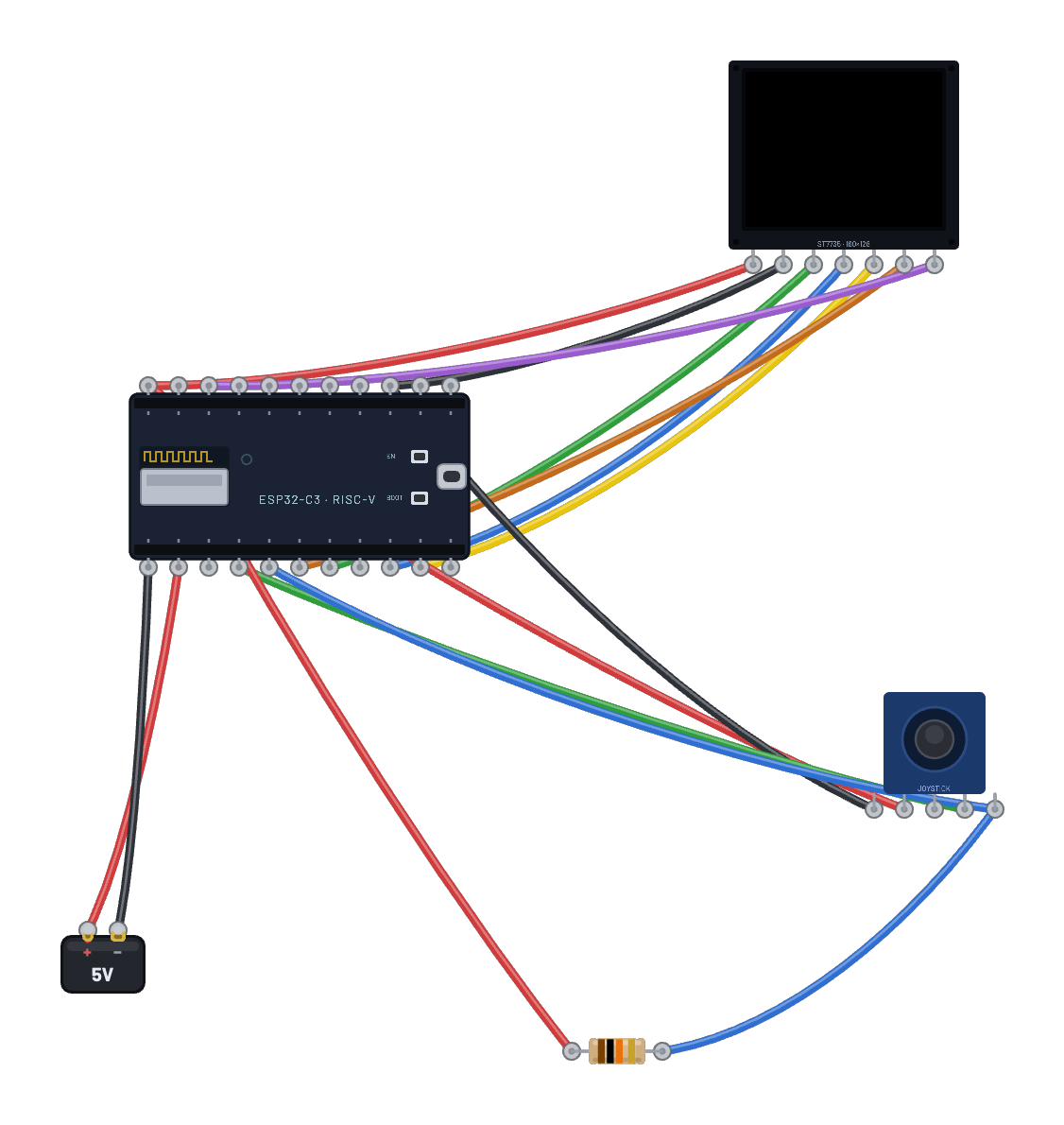
What's on the bench
- Battery
- ESP32-C6
- Joystick
- Resistor
- TFT 1.8″ 160×128 (ST7735)
How it's wired
- Battery · pos→ESP32-C6 · vin
- Battery · neg→ESP32-C6 · gnd
- ESP32-C6 · 3v3→TFT 1.8″ 160×128 (ST7735) · vcc
- ESP32-C6 · gnd2→TFT 1.8″ 160×128 (ST7735) · gnd
- ESP32-C6 · g7→TFT 1.8″ 160×128 (ST7735) · din
- ESP32-C6 · g6→TFT 1.8″ 160×128 (ST7735) · clk
- ESP32-C6 · g5→TFT 1.8″ 160×128 (ST7735) · cs
- ESP32-C6 · g3→TFT 1.8″ 160×128 (ST7735) · dc
- ESP32-C6 · g4→TFT 1.8″ 160×128 (ST7735) · rst
- ESP32-C6 · 3v3→Joystick · vcc
- ESP32-C6 · gnd2→Joystick · gnd
- ESP32-C6 · g1→Joystick · vry
- ESP32-C6 · g0→Joystick · sw
- ESP32-C6 · 3v3→Resistor · a
- Resistor · b→Joystick · sw
The code
This MicroPython script runs on the emulated board every boot; edit it in the Code tab.
# PONG - move the joystick to steer the left paddle; first to 5 wins.
# Runs on the C6 hardware SPI (sck=6, mosi=7 - the SPI(1) defaults),
# so the full 40 KB framebuffer streams at bus speed. Rendering is
# still dirty-rect - paddles repaint only the rows they gained and
# lost (the body itself never blinks), the ball draws its new cell
# before erasing the old one, points erase a couple of rects instead
# of clearing the screen, and only net dashes actually painted over
# get redrawn - a typical frame is a few hundred bytes of SPI, the
# way a tight game loop treats any serial panel.
from machine import Pin, SPI, ADC
import framebuf, time

W, H = 160, 128
TOP = 14                    # scoreboard strip; playfield is below
spi = SPI(1, baudrate=20000000)
dc = Pin(3, Pin.OUT); cs = Pin(5, Pin.OUT, value=1); rst = Pin(4, Pin.OUT)
joy = ADC(Pin(1)); joy.atten(ADC.ATTN_11DB)
btn = Pin(0, Pin.IN)

def wr(c, d=None):
    cs(0); dc(0); spi.write(bytes([c]))
    if d is not None:
        dc(1); spi.write(bytes(d))
    cs(1)

rst(0); time.sleep_ms(20); rst(1); time.sleep_ms(50)
wr(0x01); time.sleep_ms(120)   # SWRESET
wr(0x11); time.sleep_ms(120)   # SLPOUT
wr(0x3A, [0x05])                # COLMOD 16-bit RGB565
wr(0x36, [0x00])                # MADCTL: 160x128 window
wr(0x29)                        # DISPON

def rgb(r, g, b):
    # byte-swapped RGB565 (the panel wire is big-endian, framebuf little).
    v = ((r & 0xF8) << 8) | ((g & 0xFC) << 3) | (b >> 3)
    return ((v & 0xFF) << 8) | (v >> 8)

INK = rgb(240, 240, 240)
DIM = rgb(90, 100, 120)
BALL_C = rgb(120, 255, 150)

def blit(x, y, w, h, buf):
    wr(0x2A, [0, x, 0, x + w - 1])
    wr(0x2B, [0, y, 0, y + h - 1])
    cs(0); dc(0); spi.write(bytes([0x2C])); dc(1); spi.write(buf); cs(1)

def solid(w, h, color):
    b = bytearray(w * h * 2)
    if color:
        hi = color & 0xFF; lo = color >> 8
        for i in range(0, len(b), 2):
            b[i] = hi; b[i + 1] = lo
    return b

PW, PH, BS = 4, 24, 5
ball_spr = solid(BS, BS, BALL_C)
ball_gap = solid(BS, BS, 0)
pad_white = solid(PW, PH, INK)
pad_black = solid(PW, PH, 0)
dash_spr = solid(2, 5, DIM)
BALU = bytearray(9 * 9 * 2)     # ball union scratch (overlapping moves)
sb = bytearray(64 * 10 * 2)
sfb = framebuf.FrameBuffer(sb, 64, 10, framebuf.RGB565)

def net():
    for y in range(TOP + 2, H - 6, 14):
        blit(79, y, 2, 5, dash_spr)

def net_repair(x, y, w, h):
    # Redraw only the dashes a repaint actually painted over.
    if x + w <= 79 or x >= 81:
        return
    for dy in range(TOP + 2, H - 6, 14):
        if dy < y + h and dy + 5 > y:
            blit(79, dy, 2, 5, dash_spr)

def pad_repair(x, y, w, h):
    # Same idea for the paddles: the ball rect can overlap a paddle at
    # impact, so its black erase would bite a hole in the body. Re-blit
    # the rows the repaint touched (whole-width - the sprite is solid).
    for px, ptop in ((6, py), (150, cy)):
        if x + w <= px or x >= px + PW:
            continue
        y0 = y if y > ptop else ptop
        y1 = min(y + h, ptop + PH)
        if y0 < y1:
            blit(px, y0, PW, y1 - y0, memoryview(pad_white)[: PW * (y1 - y0) * 2])

def score_draw(a, b):
    sfb.fill(0)
    sfb.text('%d - %d' % (a, b), 8, 1, INK)
    blit(48, 2, 64, 10, sb)

last_msg = None
def msg(text, color):
    global last_msg
    mw = len(text) * 8 + 4
    mb = bytearray(mw * 12 * 2)
    mfb = framebuf.FrameBuffer(mb, mw, 12, framebuf.RGB565)
    mfb.fill(0)
    mfb.text(text, 2, 2, color)
    blit((W - mw) // 2, 60, mw, 12, mb)
    last_msg = ((W - mw) // 2, 60, mw, 12)

def msg_clear():
    global last_msg
    if last_msg:
        x, y, mw, mh = last_msg
        blit(x, y, mw, mh, solid(mw, mh, 0))
        net_repair(x, y, mw, mh)
        pad_repair(x, y, mw, mh)
        last_msg = None

def pad_move(x, old, new):
    # Repaint only the delta rows: the paddle body never leaves the
    # screen, so this cannot flicker, and a small move costs ~100 bytes.
    d = new - old
    if d == 0:
        return
    if d >= PH or -d >= PH:
        blit(x, new, PW, PH, pad_white)
        blit(x, old, PW, PH, pad_black)
        return
    if d > 0:
        blit(x, old + PH, PW, d, memoryview(pad_white)[: PW * d * 2])
        blit(x, old, PW, d, memoryview(pad_black)[: PW * d * 2])
    else:
        blit(x, new, PW, -d, memoryview(pad_white)[: PW * -d * 2])
        blit(x, new + PH, PW, -d, memoryview(pad_black)[: PW * -d * 2])

def ball_move(ox, oy, nx, ny):
    if ox >= 0 and abs(nx - ox) < BS and abs(ny - oy) < BS:
        # Overlapping cells: one atomic union blit.
        x0 = min(ox, nx); y0 = min(oy, ny)
        w = abs(nx - ox) + BS; h = abs(ny - oy) + BS
        mv = memoryview(BALU)[: w * h * 2]
        fbb = framebuf.FrameBuffer(mv, w, h, framebuf.RGB565)
        fbb.fill(0)
        fbb.fill_rect(nx - x0, ny - y0, BS, BS, BALL_C)
        blit(x0, y0, w, h, mv)
        net_repair(x0, y0, w, h)
        pad_repair(x0, y0, w, h)
        return
    blit(nx, ny, BS, BS, ball_spr)       # draw first: the ball never vanishes
    if ox >= 0:
        blit(ox, oy, BS, BS, ball_gap)
        net_repair(ox, oy, BS, BS)
        pad_repair(ox, oy, BS, BS)

def ball_erase(ox, oy):
    if ox >= 0:
        blit(ox, oy, BS, BS, ball_gap)
        net_repair(ox, oy, BS, BS)
        pad_repair(ox, oy, BS, BS)

# --- game state: positions in px, ball fixed-point x16, speeds in px/s ---
py = cy = (TOP + H - PH) // 2
score_p = score_c = 0
serves = 0
WIN_AT = 5

def serve(direction):
    global bx, by, vx, vy, speed, serves
    serves += 1
    bx = (W // 2 - BS // 2) * 16
    by = ((TOP + H) // 2) * 16
    speed = 70
    vx = speed * direction
    vy = ((serves * 23) % 91) - 45   # px/s, varies rally to rally
    if -10 < vy < 10:
        vy = 20

print('PONG ready - joystick = paddle, press its button to serve')
# The ONE full-frame stream: real panels power up with random RAM, so a
# real driver always clears once. Everything after this is dirty rects.
row = solid(W, 8, 0)
for y in range(0, H, 8):
    blit(0, y, W, 8, row)
net()
score_draw(0, 0)
msg('PRESS BUTTON', INK)
while btn.value() == 1:
    time.sleep_ms(30)
msg_clear()
serve(1)
state = 'play'
print('serve!')
opy, ocy = py, cy
obx, oby = -1, -1
pad_move(6, py - PH, py)
pad_move(150, cy - PH, cy)
last = time.ticks_ms()

while True:
    if state == 'over':
        if btn.value() == 0:
            score_p = score_c = 0
            msg_clear()
            ball_erase(obx, oby)
            obx = oby = -1
            score_draw(0, 0)
            serve(1)
            state = 'play'
            last = time.ticks_ms()
            print('rematch!')
        time.sleep_ms(50)
        continue

    now = time.ticks_ms()
    dt = time.ticks_diff(now, last)
    last = now
    if dt > 250: dt = 250

    # joystick Y -> paddle target, rate-limited to 120 px/s
    jv = joy.read_u16()
    target = TOP + ((65535 - jv) * (H - TOP - PH)) // 65535
    lim = 120 * dt // 1000
    dpy = target - py
    if dpy > lim: dpy = lim
    if dpy < -lim: dpy = -lim
    py += dpy

    # CPU: capped tracking - slower when the ball is moving away
    want = by // 16 - PH // 2
    if want < TOP: want = TOP
    if want > H - PH: want = H - PH
    climit = (60 if vx > 0 else 45) * dt // 1000
    dcy = want - cy
    if dcy > climit: dcy = climit
    if dcy < -climit: dcy = -climit
    cy += dcy

    # ball physics (px/s scaled by dt)
    bx += vx * dt * 16 // 1000
    by += vy * dt * 16 // 1000
    bpx = bx // 16; bpy = by // 16
    # clamp the drawn cell too: a blit rect hanging past the panel edge
    # gets its window clamped and the pixel counter wraps, smearing ball
    # pixels where the later erase cannot reach them
    if bpy <= TOP:
        by = TOP * 16; bpy = TOP; vy = -vy
    if bpy >= H - BS:
        by = (H - BS) * 16; bpy = H - BS; vy = -vy
    if vx < 0 and 6 <= bpx <= 6 + PW and bpy + BS >= py and bpy <= py + PH:
        vy += (bpy + BS // 2 - (py + PH // 2)) * 3   # deflect off the face
        speed = speed + 15 if speed < 140 else speed
        vx = speed
    if vx > 0 and 150 - BS <= bpx <= 150 + PW and bpy + BS >= cy and bpy <= cy + PH:
        vy += (bpy + BS // 2 - (cy + PH // 2)) * 3
        speed = speed + 15 if speed < 140 else speed
        vx = -speed
    if vy > 100: vy = 100
    if vy < -100: vy = -100

    scored = 0
    if bpx < 0:
        score_c += 1; scored = -1
    elif bpx > W - BS:
        score_p += 1; scored = 1
    if scored:
        print('score  YOU %d - %d CPU' % (score_p, score_c))
        score_draw(score_p, score_c)
        # No screen clear between points - just take the dead ball off.
        ball_erase(obx, oby)
        obx = oby = -1
        if score_p >= WIN_AT or score_c >= WIN_AT:
            won = score_p >= WIN_AT
            msg('YOU WIN!' if won else 'CPU WINS', BALL_C if won else rgb(255, 120, 120))
            print('game over -', 'you win!' if won else 'cpu wins', '- press the button for a rematch')
            state = 'over'
            continue
        serve(-scored)
        time.sleep_ms(250)
        last = time.ticks_ms()
        continue

    # dirty-rect repaints
    if opy != py:
        pad_move(6, opy, py)
        opy = py
    if ocy != cy:
        pad_move(150, ocy, cy)
        ocy = cy
    if obx != bpx or oby != bpy:
        ball_move(obx, oby, bpx, bpy)
        obx, oby = bpx, bpy
    time.sleep_ms(15)