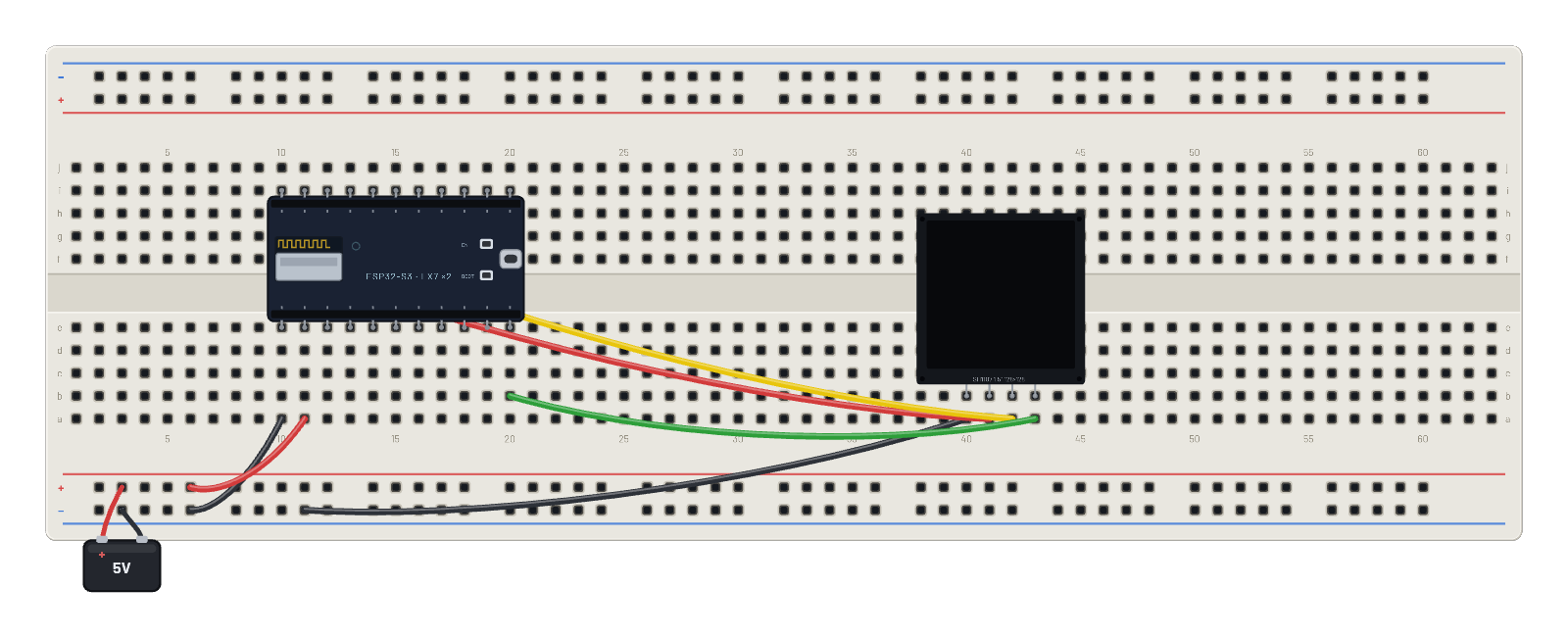
Cómo funciona
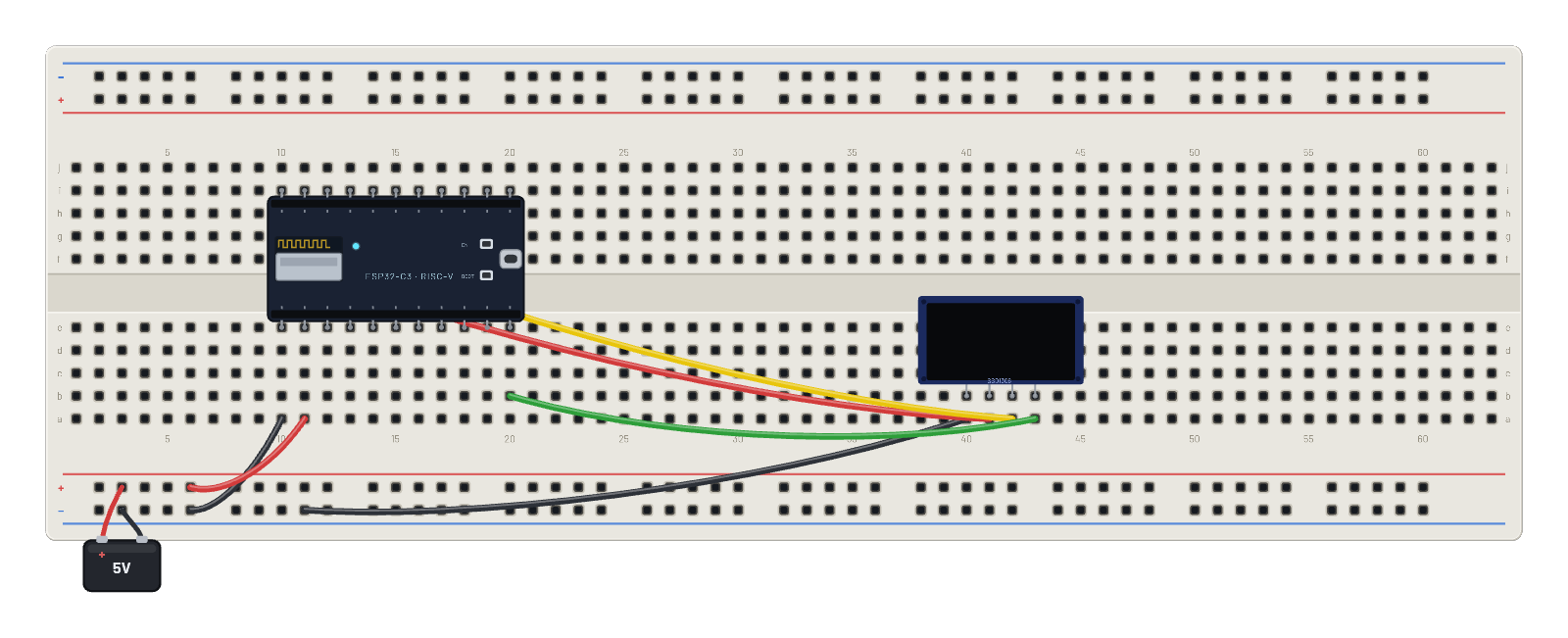
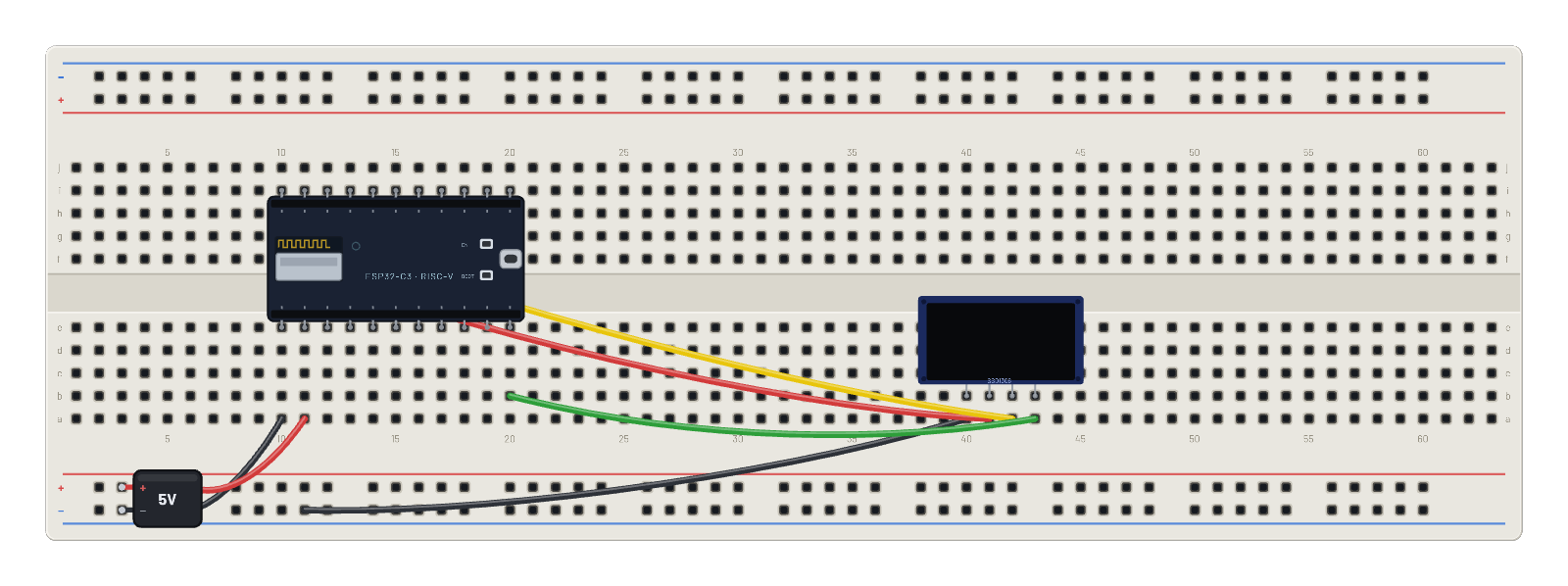
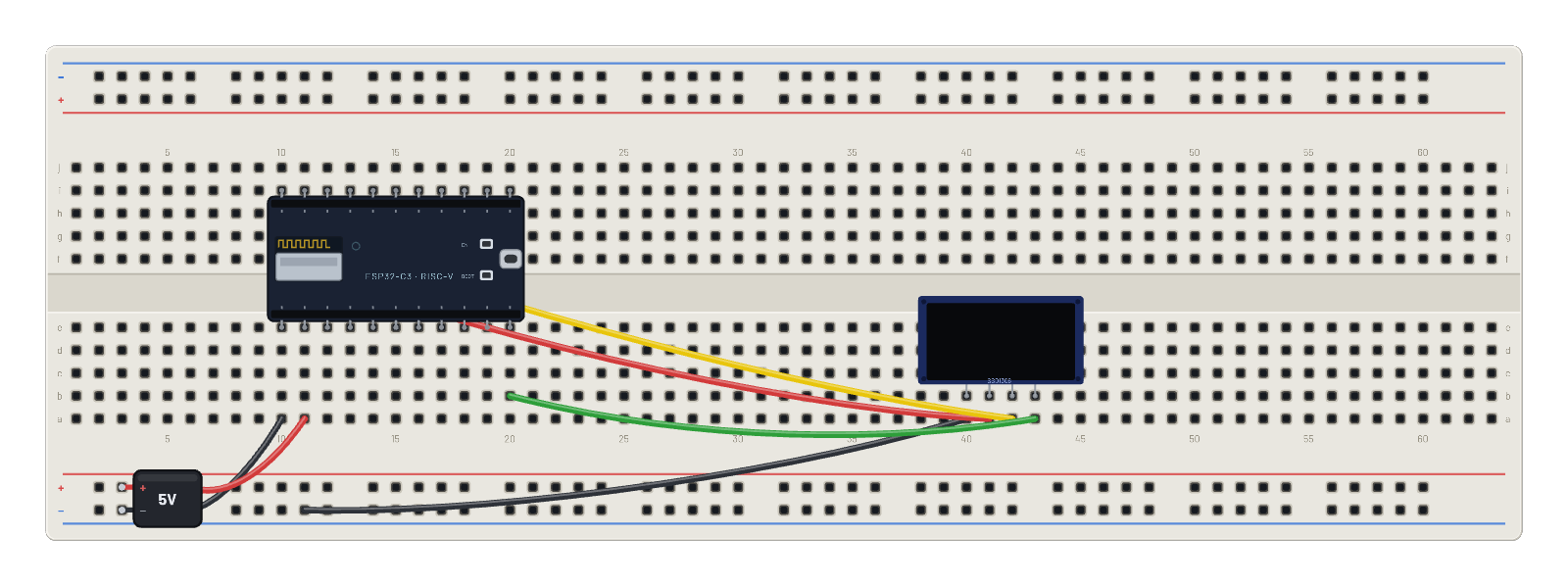
HTTP sin bibliotecas: tras conectar a BreadboardNet, el S3 de doble núcleo abre un socket a 192.168.4.1:80 cada dos segundos, envía GET / HTTP/1.0 escrito a mano y lee la respuesta directamente del flujo TCP. Estado y cuerpo aparecen en SH1107 de 1.5″ y 128×128, el doble de filas que la OLED pequeña, con contador. Cada SYN, ACK y FIN es una trama real de lwIP real.
Componentes del montaje
- ESP32-S3
- OLED 1.5″ 128×128
Cómo está conectado
- orificio a10→orificio B-5
- orificio a11→orificio B+5
- orificio a40→orificio B-9
- orificio a41→orificio f10
- orificio a42→orificio g11
- orificio a43→orificio b20
- ESP32-S3 · gnd→orificio e10
- ESP32-S3 · vin→orificio e11
- ESP32-S3 · g8→orificio e20
- ESP32-S3 · 3v3→orificio i10
- ESP32-S3 · g9→orificio i11
El código
Este script de MicroPython se ejecuta en la placa emulada en cada arranque; edítalo en Code.
from machine import I2C, Pin
import framebuf, time
i = I2C(0, scl=Pin(9), sda=Pin(8))
buf = bytearray(2048)
fb = framebuf.FrameBuffer(buf, 128, 128, framebuf.MONO_VLSB)
for c in b'\xae\x20\xa8\x7f\xd3\x00\xdc\x00\x81\x4f\xad\x8a\xa4\xa6\xaf':
    i.writeto(0x3d, bytes([0, c]))
def show():
    for p in range(16):
        i.writeto(0x3d, bytes([0x00, 0xb0 + p, 0x00, 0x10]))
        i.writeto(0x3d, b'\x40' + buf[p*128:(p+1)*128])

import network, socket
w = network.WLAN(network.STA_IF)
w.active(True)
fb.fill(0); fb.text('S3 connecting...', 0, 60); show()
w.connect('BreadboardNet')
while not w.isconnected():
    time.sleep_ms(100)
ip = w.ifconfig()[0]
n = 0
while True:
    s = socket.socket()
    s.connect(('192.168.4.1', 80))
    s.send(b'GET / HTTP/1.0\r\nHost: breadboard\r\n\r\n')
    resp = s.recv(512).decode()
    s.close()
    n += 1
    status = resp.split('\r\n')[0]
    body = resp.split('\r\n\r\n')[-1].strip()
    if n == 1:
        print(status)
        print(body)
    fb.fill(0)
    fb.text('ESP32-S3 HTTP', 0, 0)
    fb.hline(0, 10, 128, 1)
    fb.text('IP ' + ip, 0, 16)
    fb.text('GET 192.168.4.1', 0, 28)
    fb.text(status[:16], 0, 40)
    fb.hline(0, 52, 128, 1)
    for k in range(4):
        fb.text(body[k*16:(k+1)*16], 0, 58 + k*12)
    fb.text('requests: %d' % n, 0, 112)
    show()
    time.sleep_ms(2000)
Prueba esto
- Abre Wi-Fi sniffer y sigue SYN, SYN-ACK, GET, respuesta y FIN.
- Cambia la ruta a /time o /1000 en Code y observa el cuerpo.
- Observa el contador: una conversación TCP por incremento.
- Selecciona S3: dos LX7 lo ejecutan, planificados por FreeRTOS real.