Cómo funciona
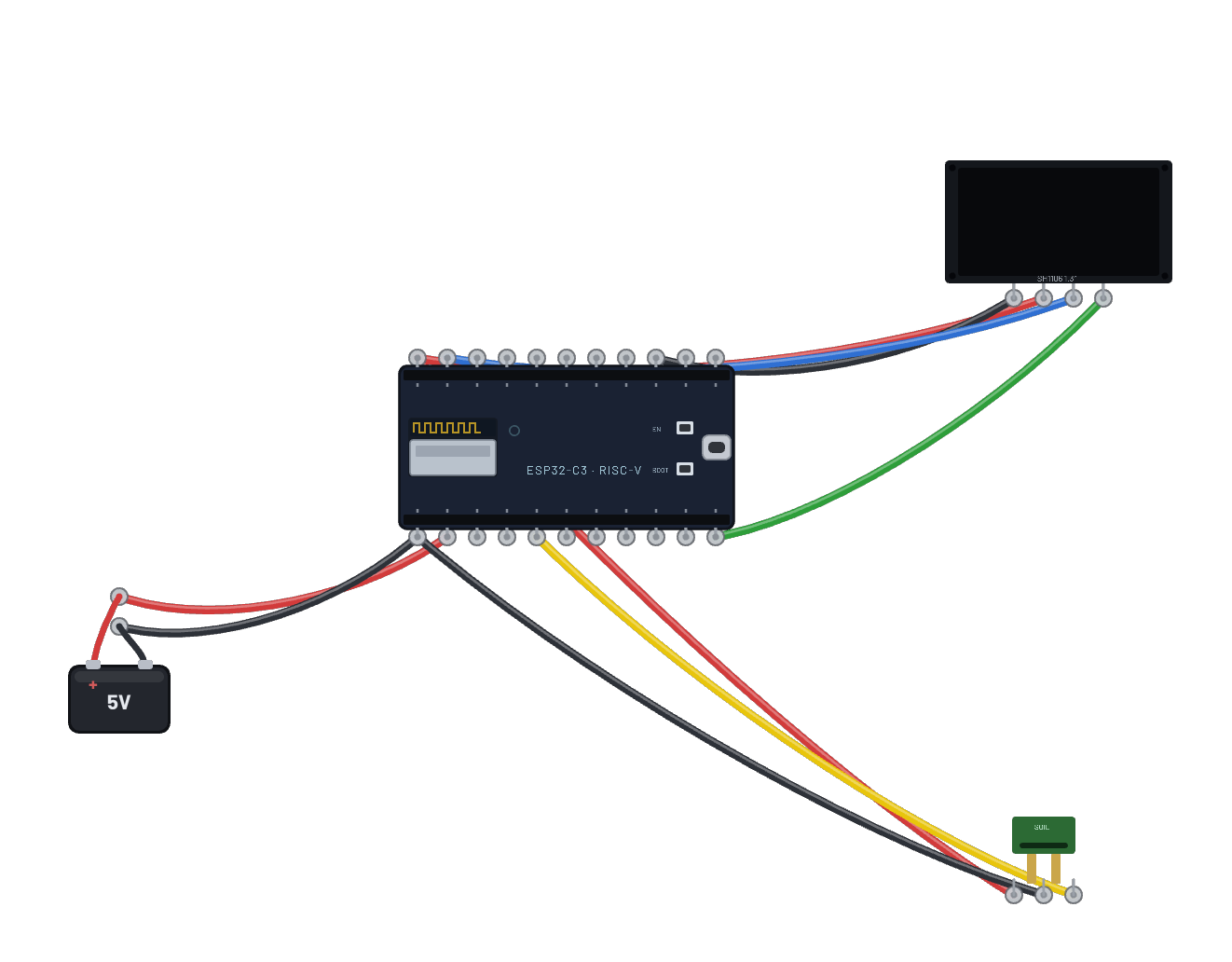
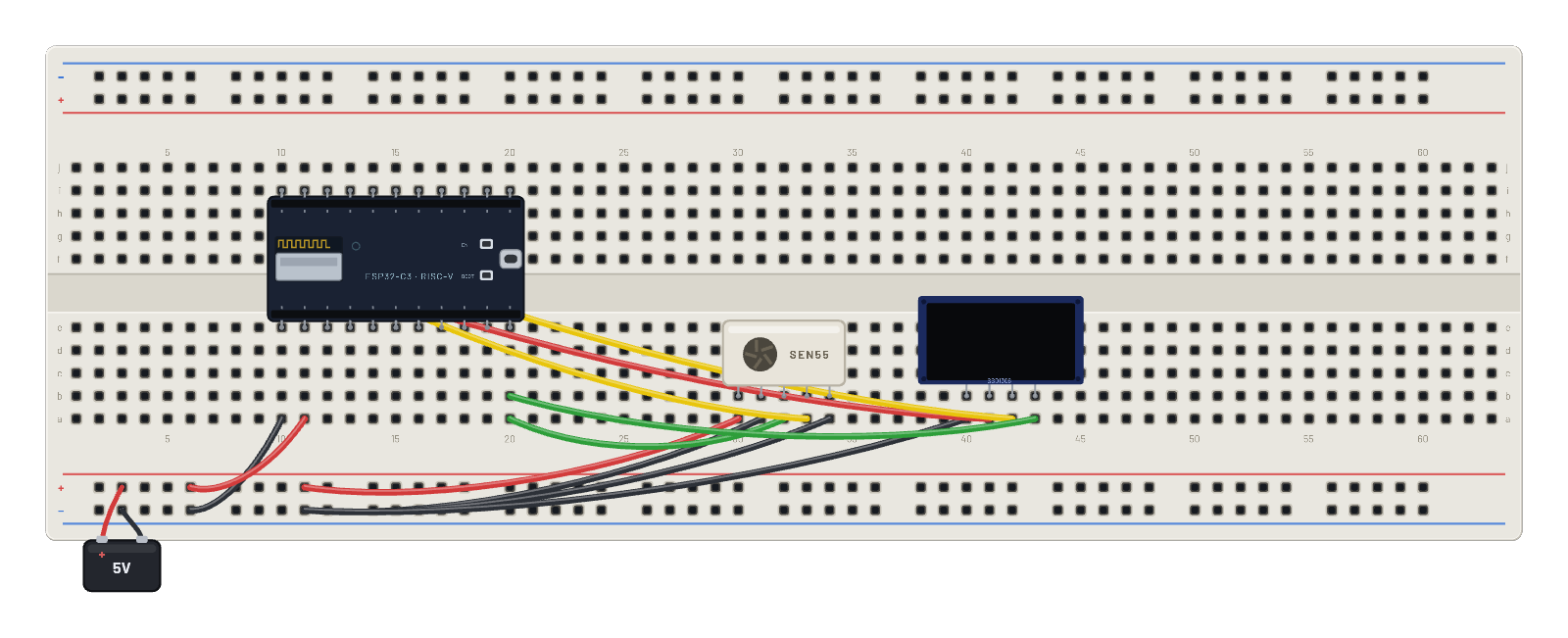
Sensirion SEN55 por I²C con sus órdenes reales: el script escribe 0x0021 en la dirección 0x69 para iniciar, consulta 0x03C4 y descompone los 24 bytes en PM2.5 (÷10), humedad (÷100) y temperatura (÷200), como firmware de producción. SEN55 está en 5 V porque su ventilador es una carga real; comparte el bus I²C C3 (SDA=G8, SCL=G9) con SSD1306, que dibuja una lectura por segundo.
Componentes del montaje
- ESP32-C3
- OLED 128×64
- SEN55
Cómo está conectado
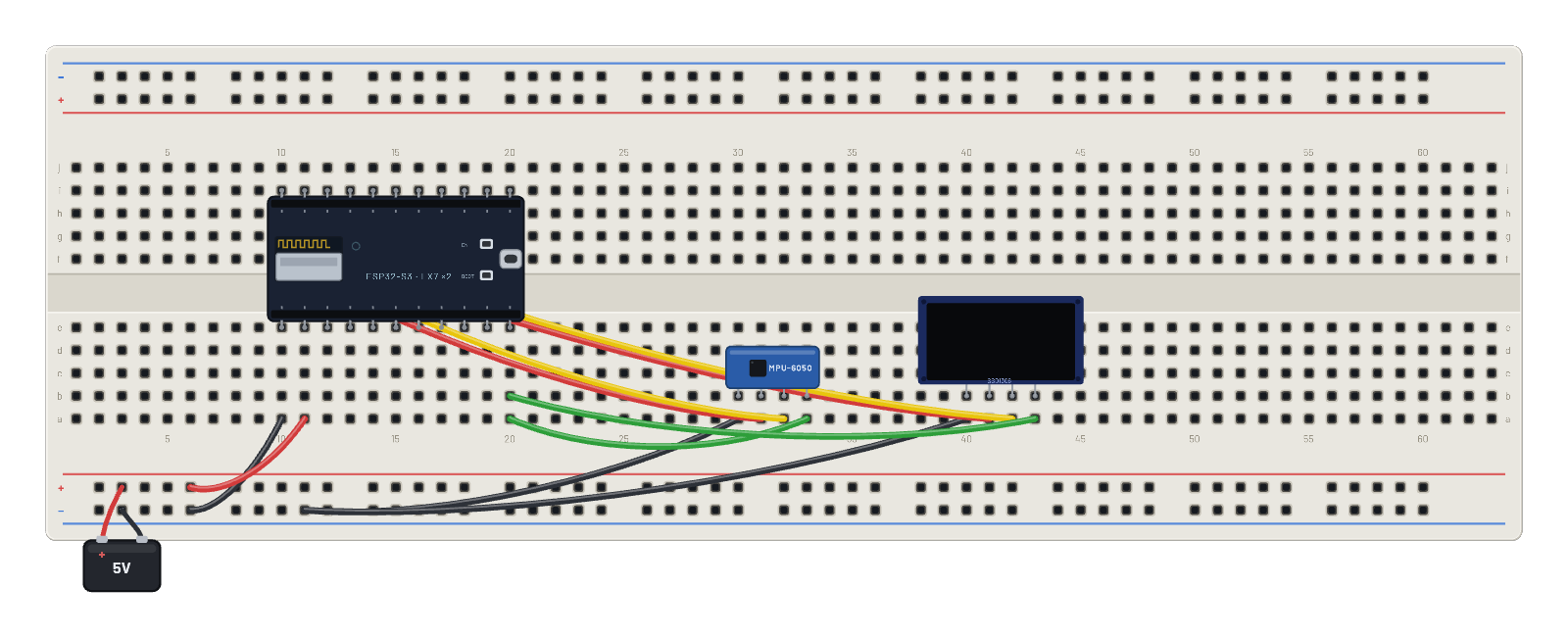
- orificio a10→orificio B-5
- orificio a11→orificio B+5
- orificio a30→orificio B+9
- orificio a31→orificio B-9
- orificio a32→orificio a20
- orificio a33→orificio f11
- orificio a34→orificio B-9
- orificio a40→orificio B-9
- orificio a41→orificio f10
- orificio a42→orificio g11
- orificio a43→orificio b20
- ESP32-C3 · gnd→orificio e10
- ESP32-C3 · vin→orificio e11
- ESP32-C3 · g8→orificio e20
- ESP32-C3 · 3v3→orificio i10
- ESP32-C3 · g9→orificio i11
El código
Este script de MicroPython se ejecuta en la placa emulada en cada arranque; edítalo en Code.
from machine import I2C, Pin
import framebuf, time
i = I2C(0, scl=Pin(9), sda=Pin(8), freq=100000)
buf = bytearray(1024)
fb = framebuf.FrameBuffer(buf, 128, 64, framebuf.MONO_VLSB)
for c in b'\xae\xd5\x80\xa8\x3f\xd3\x00\x40\x8d\x14\x20\x00\xa1\xc8\xda\x12\x81\xcf\xd9\xf1\xdb\x40\xa4\xa6\xaf':
    i.writeto(0x3c, bytes([0, c]))
def show():
    i.writeto(0x3c, b'\x00\x21\x00\x7f\x22\x00\x07')
    i.writeto(0x3c, b'\x40' + buf)

# Big digits: each pixel of the 8x8 font drawn as a k x k block
def big(s, x, y, k):
    w = 8 * len(s)
    t = framebuf.FrameBuffer(bytearray(w), w, 8, framebuf.MONO_VLSB)
    t.text(s, 0, 0, 1)
    for cx in range(w):
        for cy in range(8):
            if t.pixel(cx, cy):
                fb.fill_rect(x + cx * k, y + cy * k, k, k, 1)

# SEN55: CRC-8 (initial 0xff, polynomial 0x31), 20 ms command delay
def read_words(command, count):
    i.writeto(0x69, command)
    time.sleep_ms(20)
    d = i.readfrom(0x69, count * 3)
    words = []
    for k in range(count):
        a, b, checksum = d[k*3:k*3+3]
        crc = 0xff
        for value in (a, b):
            crc ^= value
            for bit in range(8):
                crc = ((crc << 1) ^ (0x31 if crc & 0x80 else 0)) & 0xff
        if crc != checksum: raise ValueError('SEN55 checksum mismatch')
        words.append((a << 8) | b)
    return words
def signed(value):
    return value - 65536 if value & 0x8000 else value
i.writeto(0x69, b'\x00\x21')
time.sleep_ms(50)
while True:
    if not read_words(b'\x02\x02', 1)[0]:
        time.sleep_ms(200)
        continue
    w = read_words(b'\x03\xc4', 8)
    if w[1] == 0xffff or w[4] in (0x7fff, 0xffff) or w[5] in (0x7fff, 0xffff):
        time.sleep(1)
        continue
    pm, rh, temp = w[1]/10, signed(w[4])/100, signed(w[5])/200
    fb.fill(0)
    fb.text('PM2.5', 0, 0)
    fb.text('ug/m3', 88, 0)
    big('%.1f' % pm if pm < 100 else '%d' % pm, 0, 11, 3)
    fb.text('RH', 0, 37)
    fb.text('TEMP C', 64, 37)
    big('%d%%' % round(rh), 0, 48, 2)
    big('%.1f' % temp, 64, 48, 2)
    show()
    print('PM2.5', pm, 'RH', rh, 'T', temp)
    time.sleep(1)
Prueba esto
- Selecciona SEN55 y observa PM2.5 en vivo (ambiente simulado). Varía por sí solo; compara con OLED y Serial.
- Dos dispositivos, un bus: ejecuta I2C(0, scl=Pin(9), sda=Pin(8)).scan() en REPL y encuentra 0x3c y 0x69.
- Compara con el extractor, que convierte esas mismas lecturas en control del ventilador.
- Pasa el cursor por la alimentación SEN55: 5 V, no 3V3. El ventilador lo necesita.